
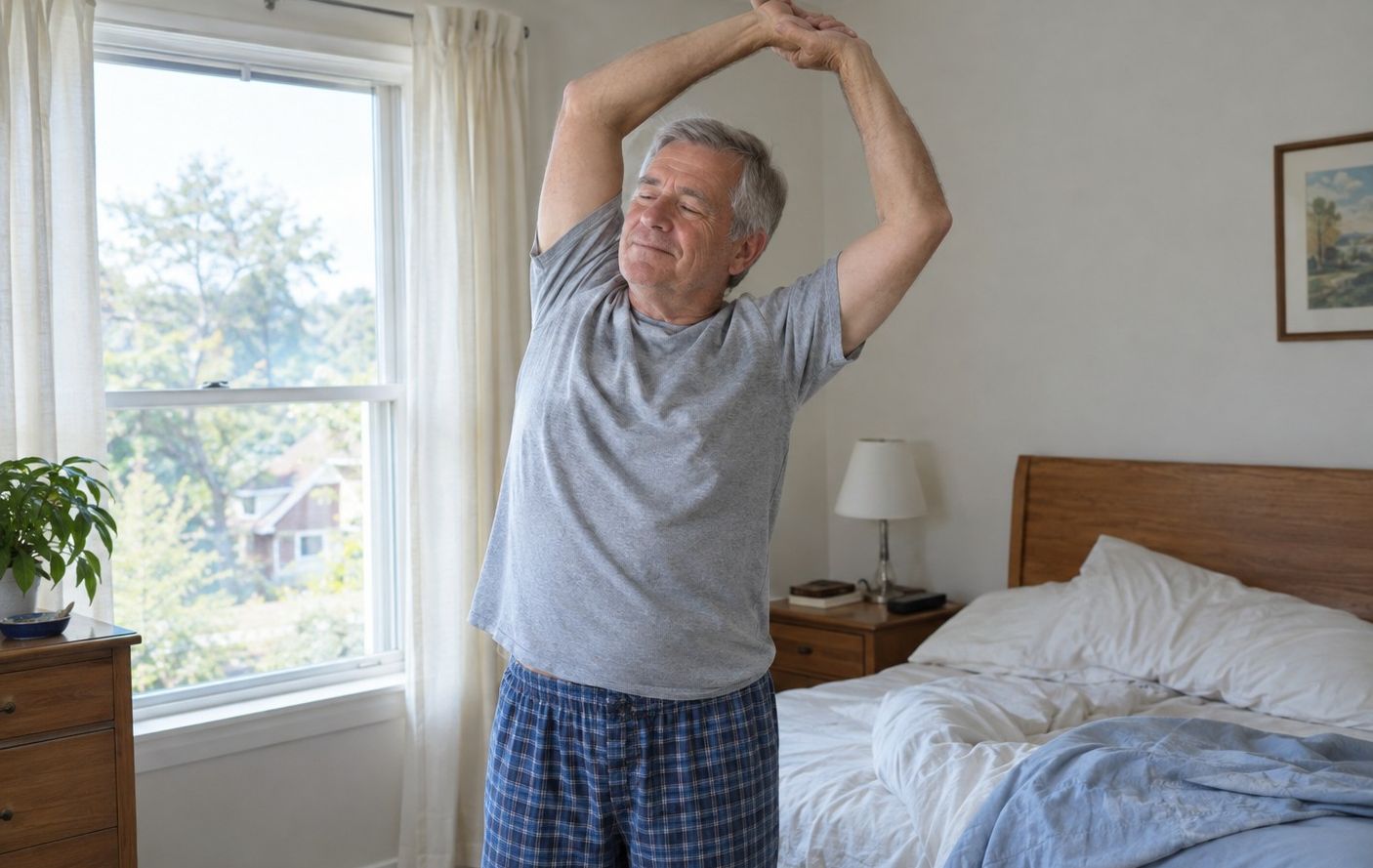
A few easy stretches can loosen you up after a night in bed. Start gently, stay at mild tension and keep breathing, and five minutes beside the bed is plenty.
You don’t need a mat or any equipment. A sturdy chair or the edge of the bed is all the support you need.
Five Easy Morning Stretches You Can Do in 5 Minutes

Before you stretch, wake your body up. Sit on the edge of the bed, roll your shoulders, then march in place or walk to the kitchen and back.
Then try these five, holding each one for about 30 seconds:
- Overhead reach: sit or stand tall and lift both arms slowly, as if reaching for a shelf.
- Seated cat-cow: sit with your hands on your knees, round your back gently, then lift your chest.
- Knee to chest: sit tall and hug one knee toward you, then switch legs.
- Standing forward bend: hold a counter, bend your knees, push your hips back and keep your back flat as you lean.
- Neck and shoulder roll: turn your head slowly to each side, then roll your shoulders back.
If you have osteoporosis or back problems, skip the forward bend and the rounding part of the cat-cow until your doctor says they are safe for you.
Stretch for flexibility and comfort, not to prevent injury. Research on stretching and injury found that stretching alone does not lower injury risk.
Adjusting Each Stretch to Your Flexibility
Everyone starts from a different place, and that’s fine. Pick the version of each stretch that feels comfortable today.
If you can’t touch your toes, bend your knees or rest your hands on your thighs. For the cat-cow, move slowly and don’t force anything.
Go only as far as mild tension, and back out if anything hurts. Harvard Health advises that a stretch should feel good, with no bouncing, and that you shouldn’t push through discomfort.
Avoid bouncing, and stay within your comfortable range of motion. Some mornings you’ll go further than others.
Slow Breathing to Start Your Day Calmly
Breathing slowly keeps your shoulders loose and your stretches smooth.
Breathe in through your nose for a count of four. Breathe out through your mouth for a count of four.
Move deliberately and never rush. Match each breath to a movement, and hold each stretch while you breathe out.
Slow breathing paces the routine and keeps you relaxed. A simple count is all you need.
Morning stretching is also a low-impact exercise that is easy on your joints.
Making Morning Stretching a Habit That Sticks

Start small. A few minutes each morning is easier to keep than a long routine you skip.
A few things make it easier to remember:
- Tie it to something you already do, like right after brushing your teeth.
- Keep a chair or mat where you can see it.
- Mark each day you finish on a wall calendar.
A short routine you repeat most days beats a long one you skip.
Once you want to move on to a longer activity, dynamic stretching can help you warm up first.
What Daily Morning Stretching Can Do for You
Harvard Health notes that flexibility can decline with age, and that a daily stretching routine can help.
Day to day, that can mean:
- Less stiffness when you get out of bed
- An easier reach for a high shelf
- A calm, unhurried start to your morning
Flexibility builds slowly, so give the routine time before you judge it.
A stretching strap can help you reach further without strain. You can compare stretching straps on Amazon if you’d like one.