

Here’s something that might change how you think about your workout schedule. Your body’s physical capabilities don’t stay constant throughout the day.
Strength, power output and flexibility all vary based on your body’s internal 24-hour clock.
A review published in Chronobiology International found that physical performance peaks when body temperature is highest. That is typically the late afternoon, around 4 to 6 PM.
Your body temperature rises roughly one degree from morning to late afternoon. That single degree correlates with meaningfully better muscle performance.
This isn’t an argument against morning workouts. It’s an invitation to understand how timing affects your goals, and to use that knowledge in a way that fits your life.
How Your Body’s Internal Clock Affects Exercise
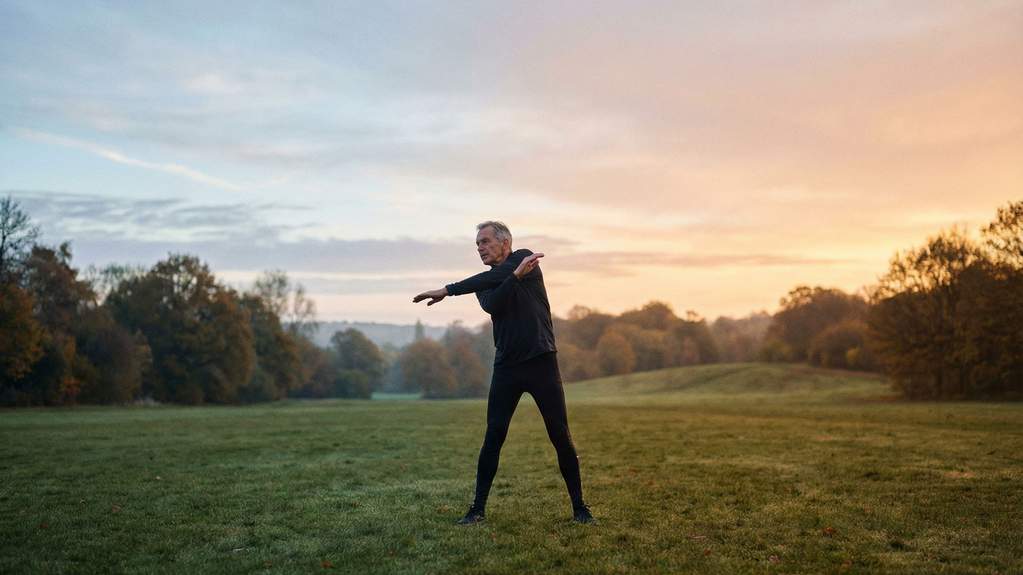
Your body follows a roughly 24-hour cycle called a circadian rhythm. Think of it as your internal scheduling system, the one that regulates when you feel alert and when you wind down.
It influences nearly every biological process, including how your muscles, heart, and lungs perform during exercise.
A central part of this rhythm is your core body temperature. It rises through the morning, peaks in the late afternoon, and drops as bedtime approaches.
Warmer muscles contract more efficiently. They’re more pliable and recover faster between efforts.
That’s why performance measures like strength, reaction time, and aerobic capacity tend to follow a similar upward curve through the day.
When scientists measure muscle force and anaerobic power at different times of day, they consistently find higher outputs in the late afternoon. The size of the gap varies with the type of exercise tested.
Cortisol, the hormone that helps wake you up and feel mentally sharp, is highest in the first 30 to 60 minutes after rising. Testosterone, which supports strength and muscle repair, also peaks in the morning for men.
Both hormones decline through the day. This is one reason the morning surge can make early sessions feel energizing, even when body temperature is still low.
Research on circadian variation in sports performance has documented these hormonal patterns and their measurable effects on exercise outcomes.
What Research Shows About Morning Exercise
Morning workouts have one practical advantage the research keeps returning to: they’re easier to protect.
Fewer things disrupt a 6 AM session than a 5 PM one. No meeting runs over. No afternoon fatigue sets in. No competing plans emerge.
Some studies find morning exercisers have adherence rates roughly 50 percent higher than those who train later. Fewer schedule conflicts arise before the day gets going.
Sleep is another benefit. Morning exercise may help anchor your circadian rhythm and support more consistent sleep timing. For anyone whose sleep schedule feels irregular, this is worth knowing.
Morning sessions often happen in a fasted state, before breakfast. Fasted exercise shifts fuel use somewhat toward fat. The effect on body composition is modest, but it’s a factor some people find motivating.
The trade-offs are real. Muscle temperature is lower in the morning, which makes a proper warm-up more important. Strength and flexibility measures run slightly lower than in the afternoon.
Who tends to do well with morning exercise: people building a new routine, those with unpredictable afternoons, and anyone whose motivation is strongest early.
What Research Shows About Afternoon and Evening Exercise

For peak physical performance, the afternoon has a clear advantage in the research.
Strength, power, and endurance all tend to be measurably higher when body temperature peaks in the late afternoon.
Reaction time improves. Breathing capacity sees a slight uptick. For anyone focused on strength gains, late afternoon training aligns well with your biology.
Sleep concerns are common with evening exercise. A 2019 systematic review in Sports Medicine analyzed 23 studies on evening exercise. Researchers found that it did not impair sleep quality for most people.
The nuance: very intense exercise ending within one to two hours of bedtime may delay sleep onset for some individuals. Finishing your session at least an hour before bed is a reasonable guideline.
For a deeper look at how exercise and sleep interact, Exercise and Sleep Quality: What the Research Reveals covers the evidence in detail.
Afternoon and evening exercise suits people who aren’t morning types. It also suits those focused on strength or performance, and anyone whose energy builds as the day goes on.
Consistency Matters More Than Timing
No timing advantage matters if you’re not showing up consistently.
Adherence is the strongest predictor of fitness results. Someone who trains at 6 AM every day will make far more progress than someone targeting the “optimal” late afternoon window. Especially if that person only gets there twice a week.
Your natural chronotype matters here. Some people are genuine morning types who wake up sharp and ready. Others are evening types who hit their stride later.
Forcing a schedule that fights your biology tends to produce frustration, not results.
The better question is not when is the best time to exercise. It’s when will you actually exercise, week after week, month after month.
If you’re building a sustainable schedule, How to Create a Simple Weekly Exercise Routine offers a practical framework. When motivation dips, How to Stay Motivated to Exercise Regularly covers what actually keeps people going.
What This Means for You
Timing research is worth knowing. Use it to make smarter choices, not to create a standard that gets in the way of actually exercising.
Small, consistent effort produces real results. That’s true at 6 AM and at 6 PM.
Here’s a practical breakdown based on the evidence:
- Strength or power is your main goal → afternoon or early evening has a slight research edge
- Endurance or cardio is your focus → timing difference is minimal. Prioritize when you have energy and time
- Weight management is your goal → fasted morning exercise may increase fat oxidation, but consistency matters far more
- Building a lasting habit is the priority → choose the time you’ll reliably keep
- Sleep quality is a concern → most evening exercise is fine. Finish intense sessions one to two hours before bed
- You’re naturally a morning person → morning works well, even with marginally lower strength metrics
- You’re naturally a night owl → evening exercise aligns better with your biology
The research on timing is real and worth knowing.
The habit is what actually produces results.
Start with the time that fits your life, protect it consistently, and let it build from there.