
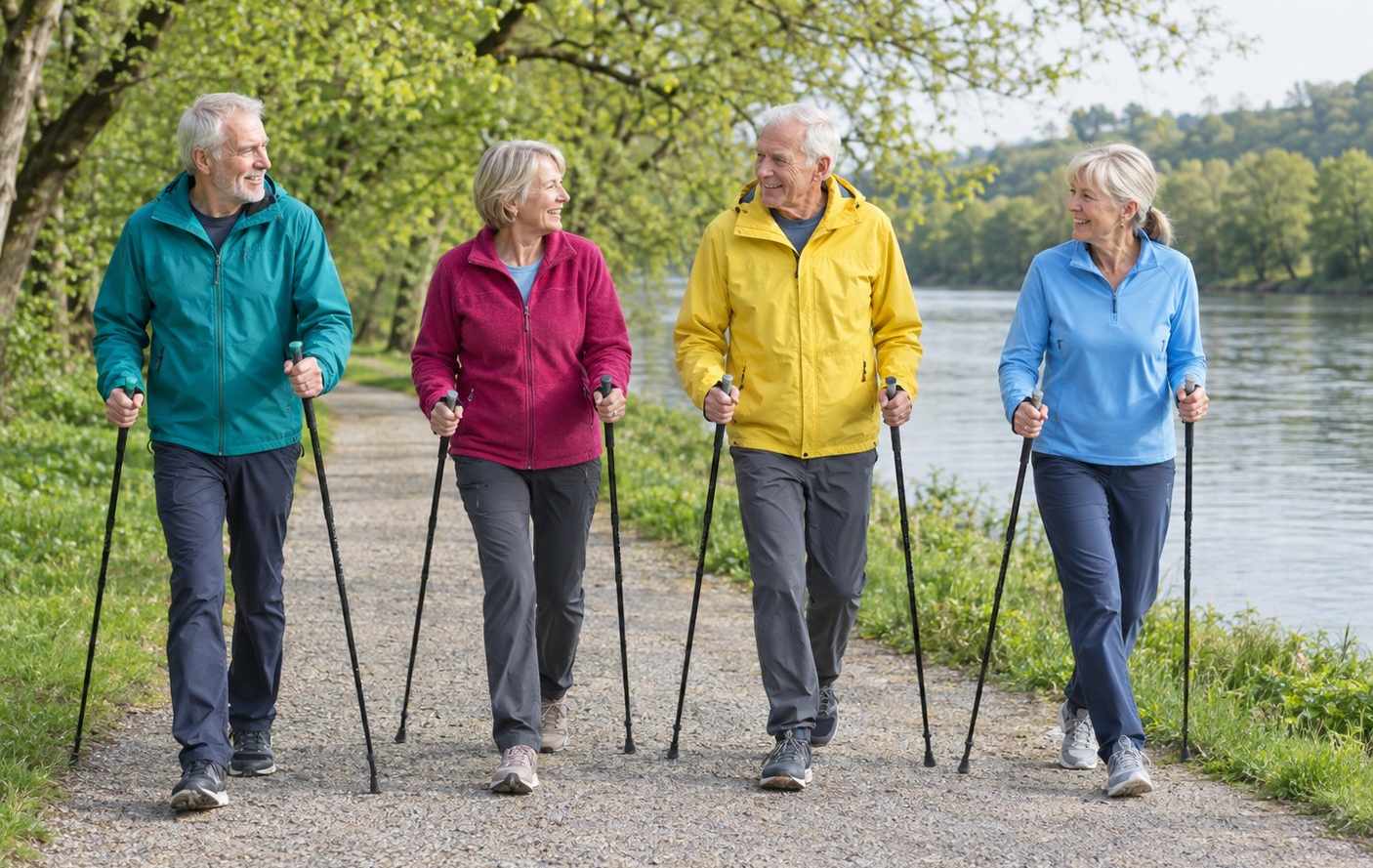
Nordic walking is ordinary walking with a pole in each hand, and each arm swings forward as the opposite foot steps.
Against no exercise, Nordic walking improved balance while moving, strength and fitness in adults aged 60 and over. A review of 15 studies in people aged 60 to 92 found those gains.
Against plain walking, the evidence is mixed. Two trials that tested poles directly against walking without poles found no extra benefit from poles on their main measures.
This is general information, not medical advice, so check with your doctor if you have concerns.
What it adds compared with doing nothing
A 2018 review in Rejuvenation Research pooled 15 studies in people aged 60 to 92. It compared Nordic walking with a group that stayed sedentary.
The review reported effect sizes, where a bigger number means a bigger difference. Nordic walking improved:
- balance while moving (0.30) and balance in everyday tasks (0.62)
- muscle strength in the arms (0.66) and legs (0.43)
- aerobic capacity, meaning stamina (0.92)
It also improved body composition (0.30) and blood fats (0.67). Balance while standing still was the exception: it seemed to get worse (-0.72).
A 2025 review in Archives of Gerontology and Geriatrics pooled 22 trials with 1,271 people, average age about 62. Compared with control groups, Nordic walking lowered body mass index, body weight and waist size.
It also lowered systolic blood pressure (the top number) by about 3 points.
What it adds compared with plain walking
The 2018 review also compared poles with walking alone.
Poles did better on balance while moving (0.30), lower-body flexibility (0.47) and quality of life (0.53). Walking alone did better on aerobic capacity (-0.21).
Two trials tested poles directly against walking without poles:
- In 33 untrained older people over 8 weeks, poles gave no greater gain in walking speed (the main outcome). The same held for most other measures. Both groups improved.
- In 74 women over 55 over 12 weeks, the two groups did not differ. Both raised their aerobic capacity and lowered their total cholesterol.
Metsähallitus, Finland’s state agency that manages state-owned land and national parks, says Nordic walking raises your heart rate more than walking. It adds that learning the right technique matters.
So poles are a way to walk, not a proven upgrade.
Plain walking already does a lot for your heart, mood and sleep. It also helps to know how walking compares with running and gym exercise.
The basic technique, step by step
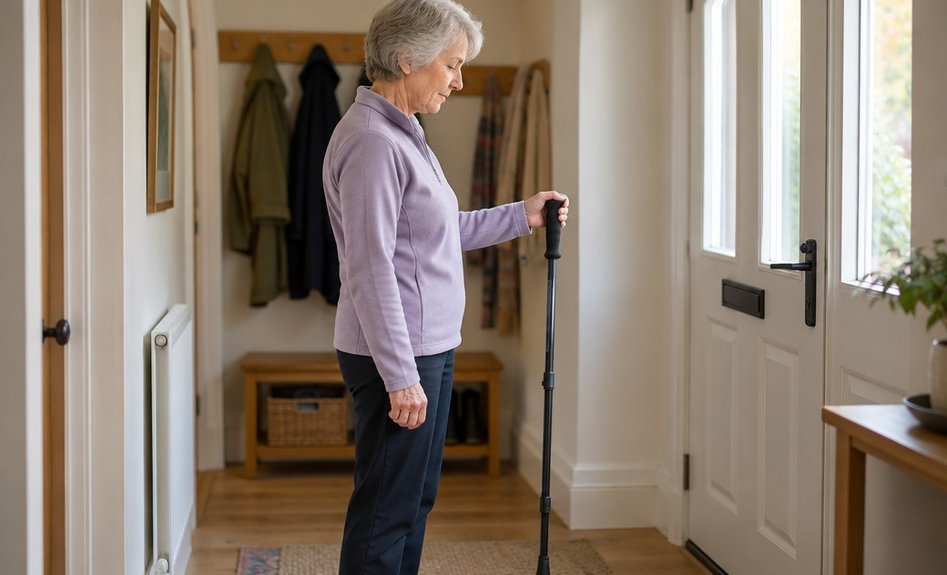
Cleveland Clinic, a non-profit academic medical center in Ohio, says Nordic walking essentially uses your normal walking motion. Its guide gives these points:
- Let the poles stay by your sides, angled back.
- Touch the pole tips down beside your leg, about midway between your two feet as you step.
- Use a gentle pole plant to push yourself forward.
- Swing your right arm forward as you step with your left foot, and the reverse.
- Take longer strides than normal, and roll each foot from heel to toes.
- Keep good posture: chin up, shoulders back, chest out.
- Don’t grip hard. Relax your hand when the pole isn’t pushing toward the ground, and let the wrist strap help you keep control.
The pole push is meant to be gentle. It is essentially your normal walking motion, with the poles helping along.
How to size your poles
Harvard Health Publishing, the consumer health publisher of Harvard Medical School, gives a quick test. Hold your forearm out at a 90° angle to your body.
The pole is the right height when your palm can cover its top.
Metsähallitus gives a formula. A beginner on level ground, who can talk while walking without getting out of breath, uses 0.62 times their own height.
Its general figure is 0.68 times your height. As a calculation, someone 5 ft 6 in (66 inches) tall multiplies 66 by 0.62. That gives about 41 inches.
In borderline cases, Metsähallitus says beginners should choose the shorter pole. Once you know your length, choosing a pair of walking poles is the next step.
Starting safely
Harvard says to get the okay from your doctor first. That applies if you are new to Nordic walking, have serious health issues, or recently recovered from an injury or surgery.
Use the poles for only part of your walk at first. Harvard suggests starting at about 25% of the time if you normally do 20- to 30-minute walks.
A few more points from the same sources:
- Start on level surfaces, such as neighborhood sidewalks or walking paths.
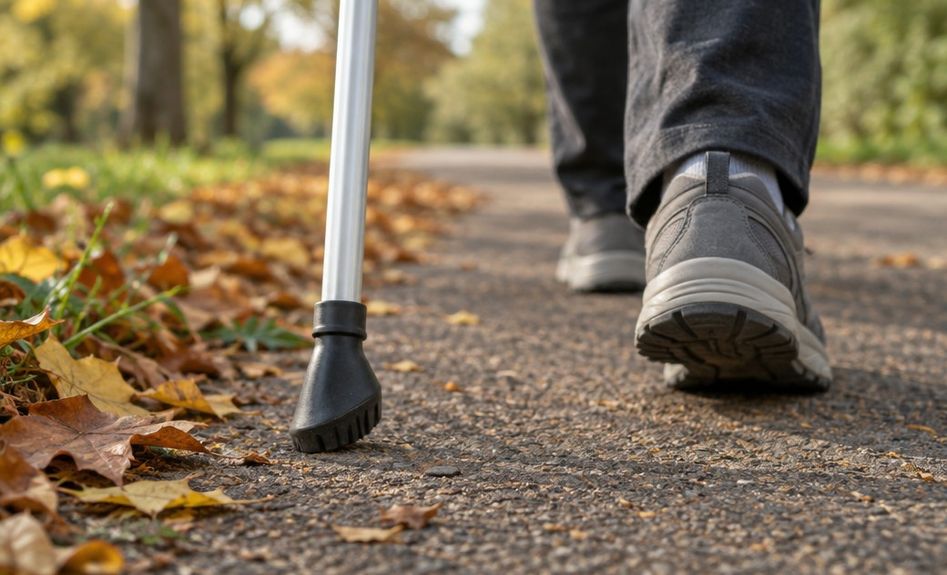
- Choose rubber tips for sidewalks and pointed tips for trails.
- Skip it while you recover from an upper-body injury. Cleveland Clinic cites the stress it might put on your wrist, shoulder and elbow joints.
Finding a group or instructor
Harvard suggests checking local walking clubs and senior centers for group Nordic walking events.
The Nordic Walking Association of North America, the continental governing body for competitive Nordic walking, runs a groups program.
On its groups page, you can join a group with an annual individual license, or start one for free. It also offers a free introductory course.
Your first outing
Pick a level sidewalk or walking path near home, and use the poles for only part of the walk.