
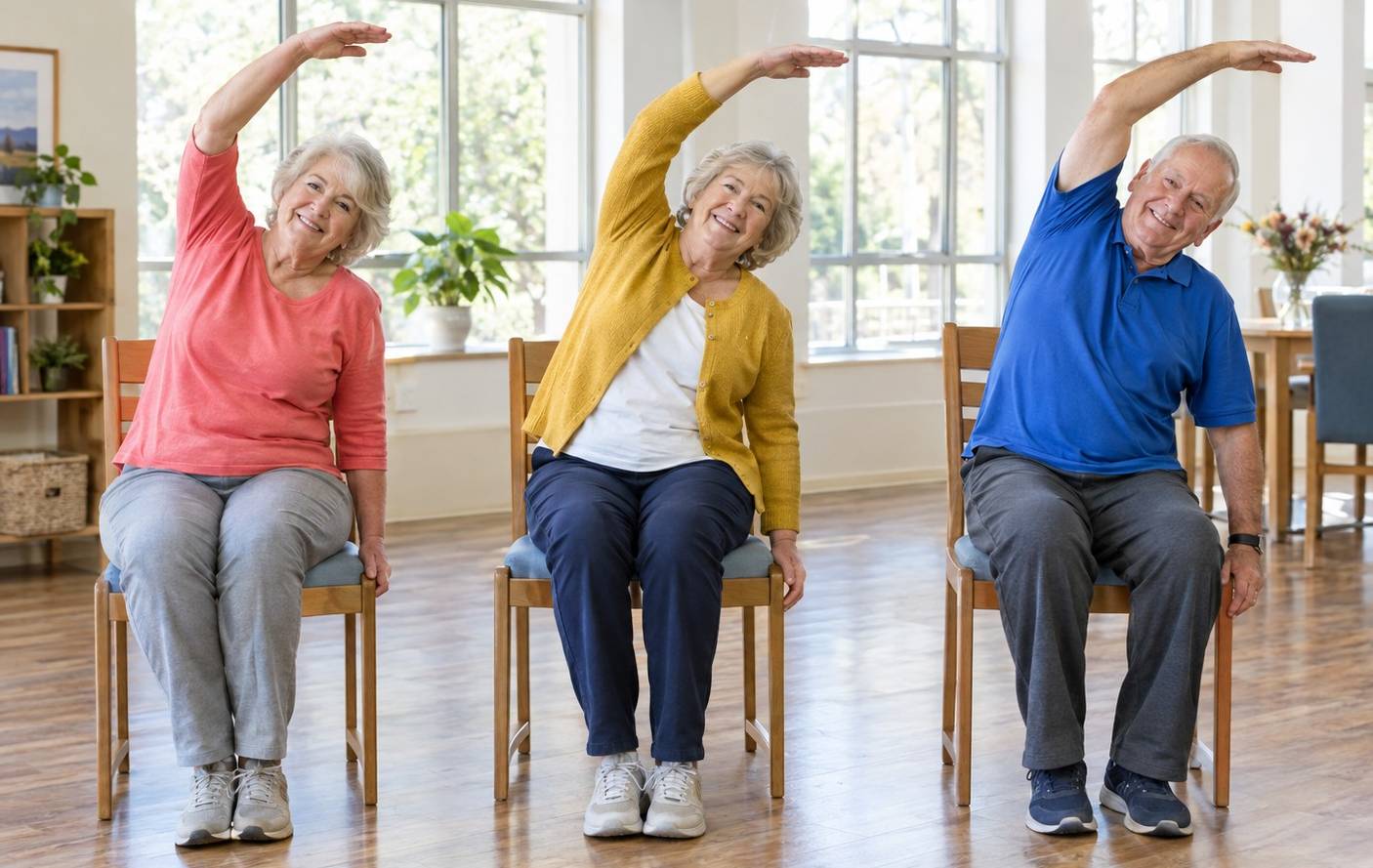
You can do this whole routine without leaving a sturdy chair. In a trial of 131 older adults with osteoarthritis in the legs, chair yoga reduced pain getting in the way of daily life more than a health-education program did.
This is general information, not medical advice, so check with your doctor if you have concerns.
What chair yoga is
Chair yoga is a set of yoga poses done sitting down, with the chair under you for support. The poses are slow stretches, gentle bends and easy twists, linked to steady breathing.
That makes it an option for people who cannot get down to the floor, or would rather not. You need no mat and no special clothes.
This routine is about stretching, breathing and slow movement. For work that builds muscle from the same seat, chair exercises that build strength cover seated presses and chair squats.
What studies of chair yoga found
The research is small and mostly short.
Pain in osteoarthritis
A pilot trial in the Journal of the American Geriatrics Society included 131 adults with osteoarthritis in the leg joints. They could not do standing exercise. Their average age was 75.
They did 45-minute chair yoga sessions twice a week for 8 weeks. A comparison group followed a health-education program.
Researchers found that the chair yoga group had a bigger drop in pain getting in the way of daily life. The gain was still there 3 months later.
- Joint pain, walking speed and tiredness also improved during the program, but those gains faded afterward.
- Chair yoga had no effect on balance in this trial.
Balance
The National Center for Complementary and Integrative Health, part of the US National Institutes of Health, points to several newer studies. They support a benefit of yoga for balance in older adults who live at home.
A 2016 review pooled 6 trials with 307 people aged 60 and over. It found a small effect on balance and a medium effect on mobility.
Those trials tested yoga-based exercise in general, not only chair yoga. The reviewers said more research is needed to know whether this prevents falls.
Mood
A preliminary study in care homes included residents aged 80 to 101, some with dementia. Seventeen did chair yoga twice a week for 8 weeks, and 16 were only assessed.
Anxiety, depression and negative mood improved in the chair yoga group but not in the other group.
Confidence in balance and quality of life did not change.
The largest trial here found no overall gain
In the UK, 454 adults aged 65 and over with two or more long-term conditions took part. Of them, 240 were offered a weekly chair-based yoga class for 12 weeks. A comparison group had their usual care.
Researchers found no meaningful difference in quality of life over 12 months. No other measure differed either, except the pain questions.
No serious harm linked to the yoga was reported.
A small earlier study of 16 older adults with past falls, median age 88, also reported no adverse events, though it had no comparison group.
The clearest result is for pain in osteoarthritis, with hints for balance and mood.
It does not show a general boost in how people rate their lives.
Set up the chair before you start
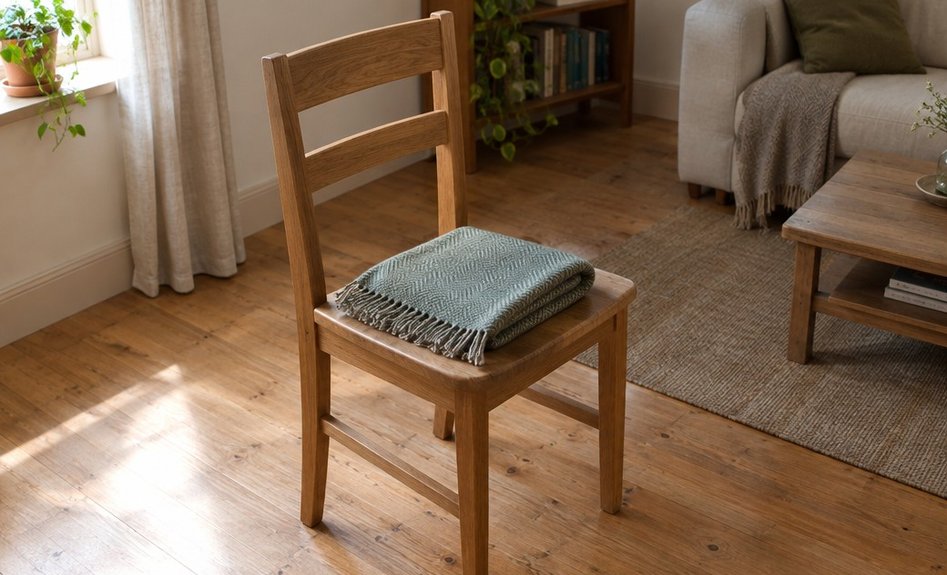
A sturdy chair is the only equipment the University of Nebraska-Lincoln’s extension service suggests. Its handout also says to breathe throughout and not hold your breath.
A fact sheet from the University of Arkansas and University of Tennessee extension services adds three rules:
- Keep your feet flat on the floor for stability.
- Avoid jerking or bouncing.
- Stop any pose that feels painful.
Older adults land in emergency departments with yoga-related injuries more often than younger adults, the National Center says. It advises beginners to avoid headstands, shoulder stands, the lotus position and forceful breathing. None of those is in this routine.
It also says older adults and people with health conditions should talk with their health care provider and the instructor. Some poses may need changes.
The nine-pose seated routine
Do each pose on both sides where it has sides.
Hold poses for 3 to 5 breaths (or 30 to 60 seconds, the Nebraska handout says), unless a pose gives its own count.
Poses 5 to 9 are held still, which makes them static stretches. These are one of several types of stretching that suit the end of a session.
1. Mountain
- Sit upright with your shoulders rolled down and back, away from your ears. Keep your head in line with your spine.
- Plant your feet on the floor directly under your knees.
- Rest your palms on your thighs, or by your sides with palms facing forward.
- Breathe in for a count of 3 to 5, then breathe out slowly until the air is gone. Stay for a few slow breaths.
Most of the Arkansas and Tennessee poses start from Mountain.
2. Cow and cat
- From Mountain, place both hands on your thighs.
- Breathe in, lift your chest and arch your back slightly. Roll your shoulders down.
- Breathe out, pull your belly button inward and round your upper back. Tuck your chin toward your chest.
- Repeat 3 to 5 times.
3. Side bend
- From Mountain, breathe in and raise your right arm overhead, palm facing inward and fingers pointing up.
- Rest your left hand on the chair seat for stability.
- Breathe out and lean gently to the left, keeping a slight bend in both elbows.
- Return to center, lower your arm, then do the other side.
4. Helicopter (seated twist)
- From Mountain, breathe in and raise your arms parallel to the floor, palms down.
- Breathe out and twist gently at the waist to the right.
- Breathe in and return to center, then twist to the left.
- Repeat 3 to 5 times.
Keep the twist gentle.
The Arkansas and Tennessee fact sheet warns that two movements can be harmful with osteoporosis: forward bending and twisting the spine. Avoid extreme spinal twists.
5. Half forward fold
- From Mountain, breathe in and raise both arms overhead, palms facing inward.
- Breathe out and lean forward from the hips until your torso and thighs form a 45 degree angle.
- Keep your back straight and your head in line with your spine.
- Hold for 3 to 5 breaths.
Bend from the hips, not the waist.
The fact sheet gives this as a way to protect the spine with osteoporosis.
6. Knee hug
- From Mountain, bring your right knee toward your chest.
- Place your hands just below the knee.
- Hold for 3 to 5 breaths, then repeat on the other side.
7. Hamstring stretch
- Sit near the front edge of the chair. Bend your left knee with the foot flat on the floor.
- Straighten your right leg out in front, heel on the floor and toes pointing up.
- Rest your hands on your left thigh and lean forward slightly from the hips. Do not place your hands on the straight leg, which protects the knee from overextending.
- Hold for 3 to 5 breaths, then switch legs.
8. Gluteal stretch
- From Mountain, place your right ankle on top of your left thigh, just behind the knee.
- Rest your right hand on your right knee and your left hand on your right ankle.
- Hold for 3 to 5 breaths, then switch sides.
If this is too hard, keep both feet on the floor and cross your ankles instead.
9. Eagle
- Sit up tall on the front of the chair. Pull your shoulders back and down.
- Cross your left foot over your right. Hold your left arm up at a 90 degree angle.
- Wrap your right arm around your left arm and grab your left thumb or wrist.
- Slowly push your hands up toward the ceiling and hold for 3 to 5 breaths, then repeat on the opposite side.
A first week of chair yoga
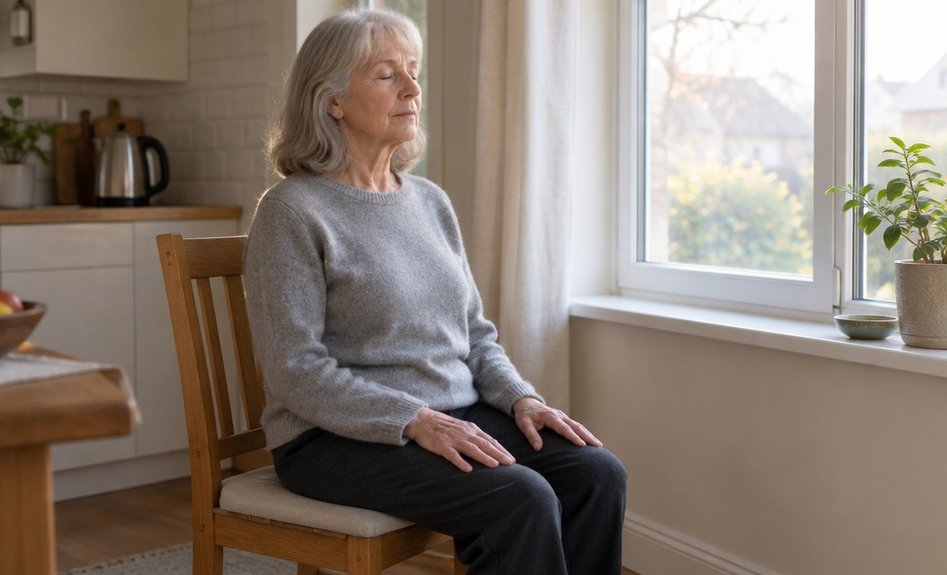
Three of the studies here used two sessions a week, so twice a week is a reasonable start.
For the first week, do five poses: Mountain, cow and cat, side bend, helicopter and knee hug. That leaves the forward fold and the harder leg stretches for week two.
Once those feel easy, add the half forward fold, the hamstring stretch, the gluteal stretch and the eagle.
Some of the stretches in a five-minute morning routine are done standing or on the floor, so take only the ones that suit you.
Tomorrow morning, do Mountain pose in your sturdiest chair, then repeat cow and cat three times.