
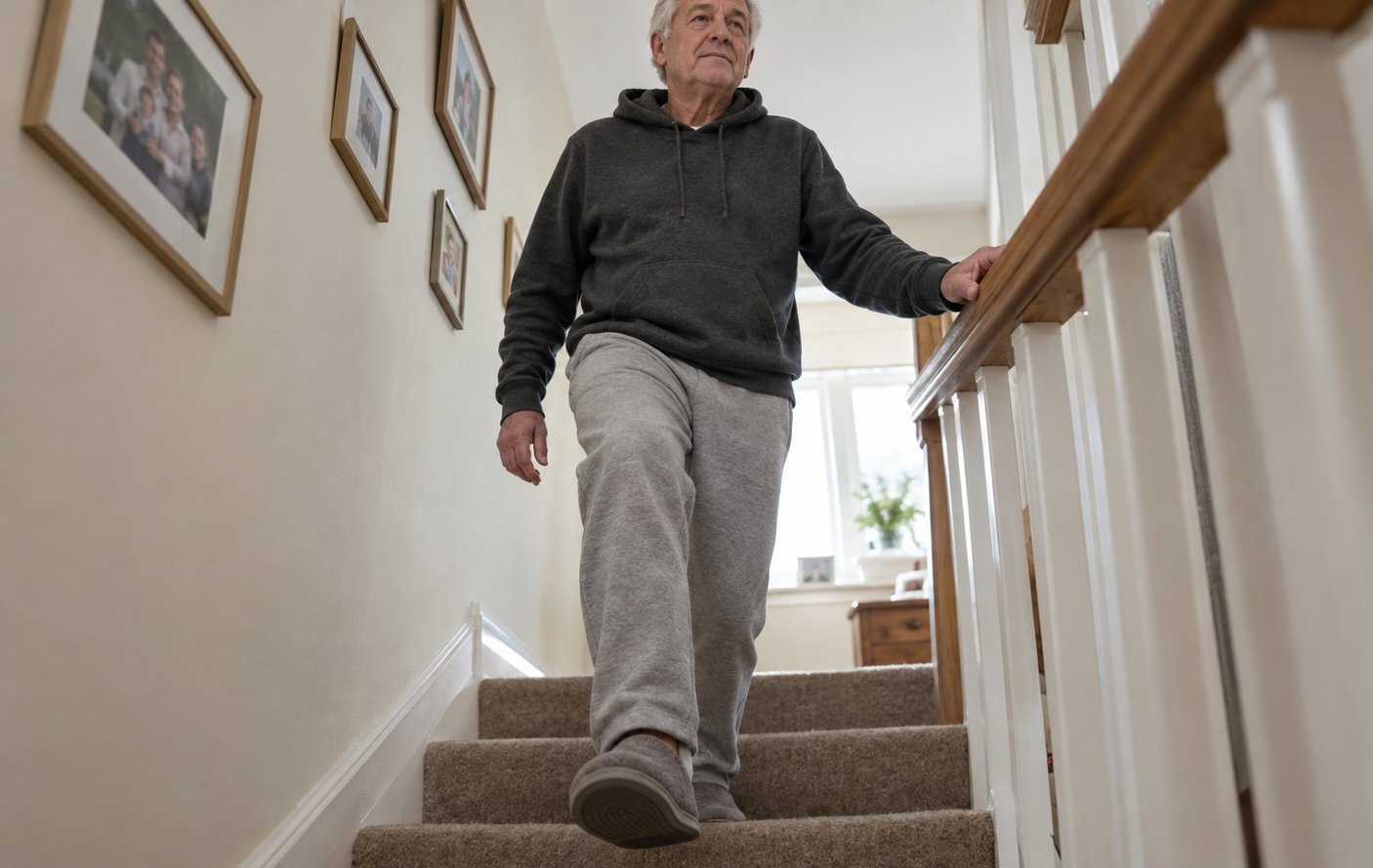
Standing up from a chair and climbing stairs both lean heavily on the thigh muscles.
In a study of 4,449 US adults aged 50 and older, researchers named the knee extensors as the key muscle group for sit-to-stand moves. Those are the muscles at the front of the thigh.
The short answer is the eight-move ladder below, done on two days a week, starting with the easiest move. You need a sturdy chair, a wall and a low step or sturdy box.
This is general information, not medical advice, so check with your doctor if you have concerns.
The National Institute on Aging, the US government’s research agency on aging, adds one caution: with knee or back problems, talk with your doctor before trying the chair stand.
Why leg strength matters
The same thigh muscles that lift you out of a chair also help you keep your balance and walk steadily. That is how the study above describes them.
In the same group of adults, low knee extensor strength was linked to a higher risk of dying from any cause, independent of muscle mass. That is an association. It does not prove that training lowers the risk.
Cochrane, an independent network that reviews medical research, reports that at least one-third of people over 65 who live at home fall each year.
Pooling 59 of its trials, with 12,981 participants, it found that exercise of all kinds together cut the rate of falls by 23%.
What strength alone can and cannot do
Strength training on its own is not proven to prevent falls.
An updated 2020 review prepared for the World Health Organization’s guidelines calls the effect of programs that mainly use resistance training uncertain.
Programs that combined several types of exercise cut falls by 28%. These were commonly balance and functional work plus resistance exercises.
So pair this ladder with balance work. The US Department of Health and Human Services, the federal health department, advises the same mix: balance training alongside aerobic and muscle-strengthening activity.
Balance can be trained too, and the research on how balance training prevents falls covers tai chi and the Otago program.
How the ladder works
Do the moves in order, on two days a week. The National Institute on Aging (NIA) advises muscle-strengthening activity on at least two days a week.
For most moves, NIA’s everyday exercise guide gives two rounds of 10-15 repetitions, per leg for the one-leg moves. Breathe in slowly to start, breathe out as you lift or rise, and breathe in as you lower.
In NIA’s moves, each hold is 1 second. Move slowly in both directions.
If standing work is not comfortable yet, chair exercises for building strength are a place to start.
The ladder, from easiest to hardest
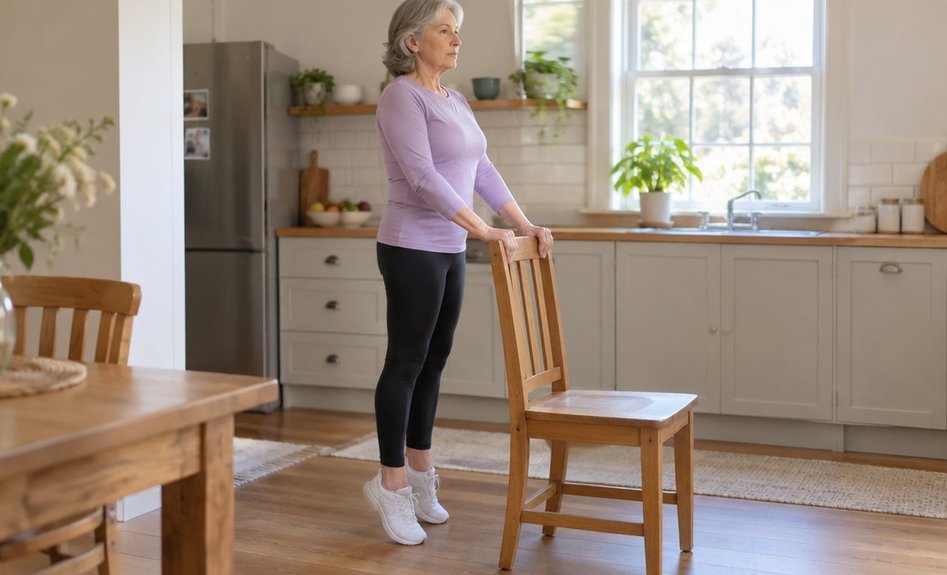
1. Toe stand
NIA says this one strengthens your calves and ankles and helps make walking easier.
- Stand behind a sturdy chair, feet shoulder-width apart, holding on for balance.
- Breathe out and slowly rise onto your tiptoes, as high as you can.
- Hold for 1 second.
- Breathe in as you slowly lower your heels to the floor.
Do 10-15, rest, then do 10-15 more.
2. Leg straightening
This seated move strengthens your thighs, and NIA says it may reduce symptoms of arthritis of the knee.
- Sit in a sturdy chair with your back supported. Only the balls of your feet and your toes rest on the floor.
- Put a rolled bath towel at the edge of the chair under your thighs for support.
- Breathe out and slowly straighten one leg in front of you, but do not lock your knee.
- Flex your foot so your toes point to the ceiling, and hold for 1 second.
- Breathe in as you slowly lower the leg.
Do 10-15 with one leg, then 10-15 with the other. Then repeat 10-15 more with each leg.
If your knees ache, how much discomfort is acceptable when exercising with knee osteoarthritis is worth reading first.
3. Back leg raise
NIA says this move strengthens your buttocks and lower back.
- Stand behind a sturdy chair, holding on for balance.
- Breathe out and slowly lift one leg straight back. Do not bend your knee or point your toes.
- Try not to lean forward. The leg you are standing on should be slightly bent.
- Hold for 1 second, then breathe in as you slowly lower the leg.
Use the same rep line as the leg straightening: 10-15 with each leg, then 10-15 more with each leg.
4. Side leg raise
NIA says this move strengthens your hips, thighs and buttocks.
- Stand behind a sturdy chair with your feet slightly apart, holding on for balance.
- Breathe out and slowly lift one leg out to the side. Keep your back straight and your toes facing forward.
- The leg you are standing on should be slightly bent.
- Hold for 1 second, then breathe in as you slowly lower the leg.
The rep line is the same: 10-15 with each leg, then 10-15 more with each leg.
5. Knee curl
NIA says walking and climbing stairs are easier when you do both the knee curl and the leg straightening.
- Stand behind a sturdy chair, holding on for balance. Lift one leg straight back without bending your knee or pointing your toes.
- Breathe out and slowly bring your heel up toward your buttocks as far as you can.
- Bend only from the knee, and keep your hips still. The leg you are standing on should be slightly bent.
- Hold for 1 second, then breathe in as you slowly lower your foot to the floor.
Do 10-15 with each leg, then 10-15 more with each leg.
6. Chair stand
This is the move that copies standing up from a chair, and it asks for no hands. Check with your doctor first if you have knee or back problems.
- Sit toward the front of a sturdy, armless chair, knees bent and feet flat on the floor, shoulder-width apart.
- Lean back with your hands crossed over your chest. Keep your back and shoulders straight throughout.
- Breathe out and bring your upper body forward until you are sitting upright.
- Extend your arms so they are parallel to the floor, and slowly stand up.
- Breathe in as you slowly sit down.
Do 10-15, rest, then do 10-15 more. NIA’s tip for people with back problems is to start from the sitting upright position.
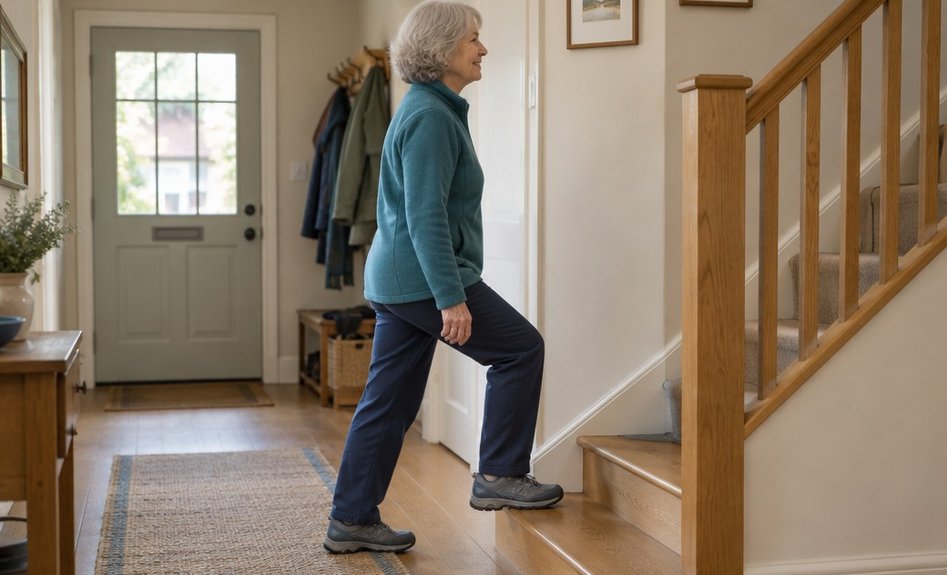
7. Step-ups
The University of Illinois Extension, the university’s public education service, says this move helps build leg strength and balance.
- Find a step or sturdy box.
- Step up with one foot, then bring the other foot up.
- Step back down, one foot at a time.
Do 10 on each side.
8. Wall sit
This is the last rung, and the Illinois page gives it a hold time as well as a count.
- Stand with your back flat against the wall, your feet a few inches ahead of you.
- Slide down until your knees are bent, as if you were sitting in an invisible chair.
- Keep your knees above your ankles in an L shape and hold for 10 to 30 seconds. Squeeze the muscles in your thighs and your bottom.
- Slowly slide back up.
Rest, and repeat 3 times.
How to know when to move up
The NIA guide and the Illinois pages give their own cues for making a move harder, and none of them is a score.
- Leg straightening, back and side leg raises, knee curl: NIA says you may want to add ankle weights as you progress.
- Toe stand: try it standing on one leg at a time, for a total of 10-15 times on each leg.
- Step-ups: do them without holding onto anything.
- Wall sit: hold for more seconds each time.
For a periodic check, the 30-second chair stand test measures leg strength and endurance.
It comes from the Centers for Disease Control and Prevention (CDC), the US federal public health agency. On the CDC form, a score below average for your age signals a higher risk of falling.
Choose a number of weeks that suits you, put the date on your calendar, and retest with the chair stand test when it comes round.