
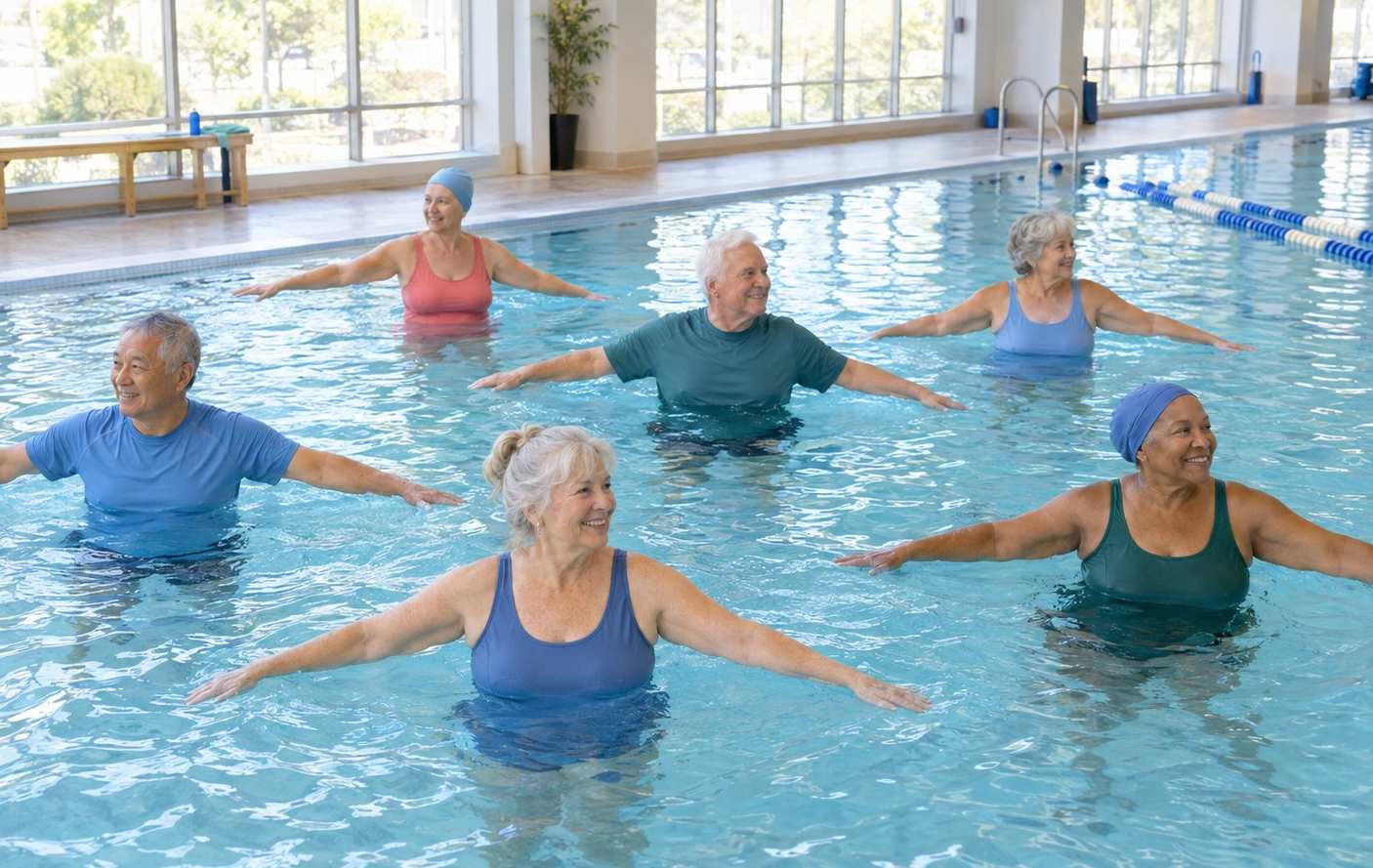
Yes, water aerobics counts as real exercise. The CDC, the US federal public health agency, lists exercise classes like water aerobics as a moderate-intensity activity.
The Arthritis Foundation, a US nonprofit organization focused on arthritis, notes that aquatic workouts put less stress on joints. You still work your heart and muscles.
This is general information, not medical advice. Check with your doctor first if you have a heart, lung or joint condition.
Why it counts as exercise
Moderate-intensity has a simple test. According to the CDC, you should be able to talk but not sing while you move.
The CDC’s weekly target for adults is 150 minutes of moderate-intensity activity. A 30-minute class on five days a week adds up to that target.
Water exercise is also low-impact exercise, which keeps joint strain down without keeping effort low.
What the studies of aquatic exercise found
Cochrane, a charity that publishes reviews of clinical trials, looked at aquatic exercise for knee and hip osteoarthritis. Its review includes 13 trials with 1,190 participants.
Most participants were women, with an average age of 68. The aquatic programs lasted 12 weeks on average.
Compared with control groups, in the short term:
- Pain and disability were about five points lower on a 0 to 100 scale.
- Quality of life was about seven points higher.
- No serious adverse events were reported.
The authors call the evidence moderate in quality, with small, short-term effects.
A second review looked at balance. Researchers in China pooled 29 trials with 1,486 older adults, average age 66. They concluded that aquatic exercise improved balance more than land-based exercise.
The trials differed a lot, so treat that result as encouraging, not settled.
The page on exercise for osteoarthritis in the knees adds that the buoyancy of water reduces joint load. That makes chest-deep water moves well suited to a flaring knee.
What a class involves
The Arthritis Foundation suggests checking with your local YMCA or rec center, which often offer free or low-cost classes.
You do not need to know how to swim, according to a Mayo Clinic guide republished by Beacon Health System. You stand in the water and follow an instructor.
In a class, the trainer makes sure you warm up and cool down, says the Arthritis Foundation.
Water that feels pleasantly warm helps. The University of Washington’s Department of Orthopaedic Surgery and Sports Medicine says 83 to 88°F is usually comfortable for exercise.
Eight pool moves to try alone
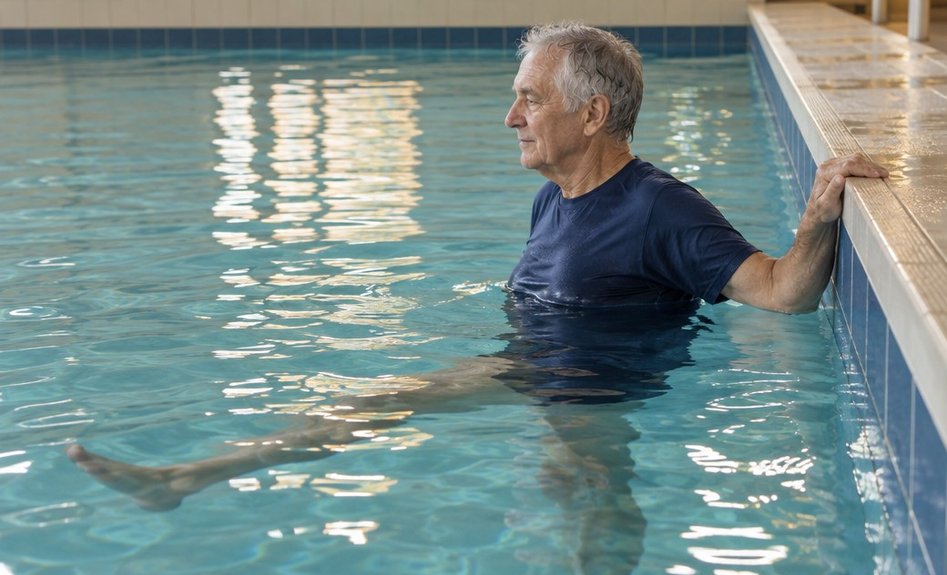
The same University of Washington department publishes water exercises for people with arthritis. These eight come from its list. The page’s full set can be done sitting or standing; these eight are done standing.
Several use the pool wall for balance. Begin and end with easy exercises.
- Walking. Walk normally across the pool or in a circle, swinging your arms.
- Sideways arm reach. Slowly raise both arms out to the sides, palms down, to shoulder (water) level. Then lower them.
- Arm circles. Raise both arms forward until they are a few inches below the water, elbows straight. Make small circles, then bigger ones, then smaller again. Do inward circles first, then outward. Keep your arms under the water and do not let them cross.
- Knee lift. Stand with your back or side against the pool wall. Bend one knee to bring the thigh parallel to the water surface. Straighten it, then bend it again. Lower the leg with the knee bent. Repeat on the other side.
- Leg swing. Stand with one side to the wall, holding on with the hand nearest it. Keep your knees straight. Lift the outer leg slowly forward to a comfortable height. If possible, hold for a count of 5, then swing it slowly backward. Move only at the hip and keep your upper body straight. Repeat on the other side.
- Side leg lift. Stand with one side to the wall, holding on, knees relaxed. Swing the outer leg out toward the center of the pool and back to the midline. Do not cross in front of the other leg. Repeat on the other side.
- Calf stretch. Stand with one side to the wall, holding on, legs slightly apart and the near leg forward. Keep your body straight and lean forward slowly, letting the front knee bend. Keep the back knee straight and the heel on the bottom. Return to start and switch legs.
- Side bend. Put your hands on your hips and, without moving your feet, bend slowly to one side. Return to the start and bend to the other side. Do not twist or turn your trunk.
The Arthritis Foundation guidelines on that page say to do three to eight repetitions as tolerated. Keep the part you are working under the water. Stop if you feel any sudden or increased pain.
The Arthritis Foundation also advises you to start slowly and gently, and work up to more intense movements as you get warmer.
When to check with a doctor first
Ask your doctor first if you have lung or heart disease, circulatory problems, high or low blood pressure or diabetes. The University of Washington department also lists skin irritations and any other serious illness.
People with severe joint damage or joint replacements should check with their doctor or surgeon before doing these exercises.
Anyone who feels lightheaded or nauseated should get out of the water immediately.
Pain that lasts more than one to two hours afterward may indicate overuse, so cut back next time. The steps for exercising safely with joint pain explain how to tell that pain from normal effort.
If water makes you nervous, the Arthritis Foundation says gear like kickboards and flotation vests may help.
What to pack for your first class
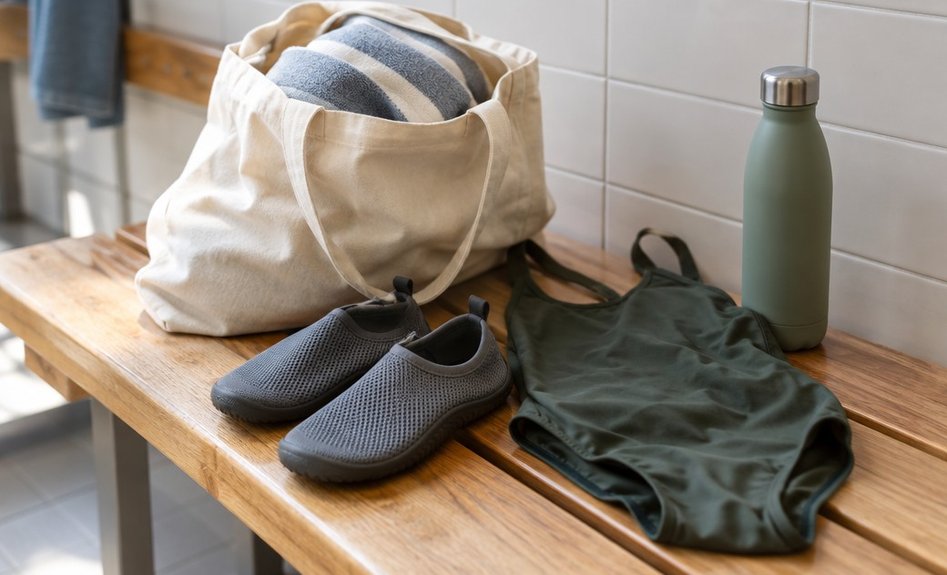
Pack a swimsuit, a towel and water shoes, which help you keep traction on the bottom of the pool. If you are nervous in the water, ask the instructor about a flotation vest or a kickboard.