

All you need is a sturdy kitchen chair without arms and a way to count 30 seconds.
The Centers for Disease Control and Prevention (CDC), the US federal public health agency, publishes the scores to compare against. At 70 to 74, fewer than 12 stands for men or 10 for women counts as below average.
A below-average number is not a verdict. It tells you where your leg strength stands today, and leg strength is something you can build.
What the chair stand test tells you
The test was developed by researchers at California State University, Fullerton. They checked it on 76 adults living independently, with an average age of about 70.
Chair-stand counts lined up fairly closely with how much weight the same people could push on a leg-press machine. The number reflects real leg strength, not just how hard you tried that day.
Scores fell from the 60s to the 70s to the 80s. They were also clearly lower in people who were less active, the researchers reported in 1999.
That second finding is the hopeful one. Activity shows up in the score, not only age.
The same team later published fitness standards for ages 60 to 94 linked to staying physically independent. This article uses the CDC’s simpler below-average table instead.
How to do the test safely at home
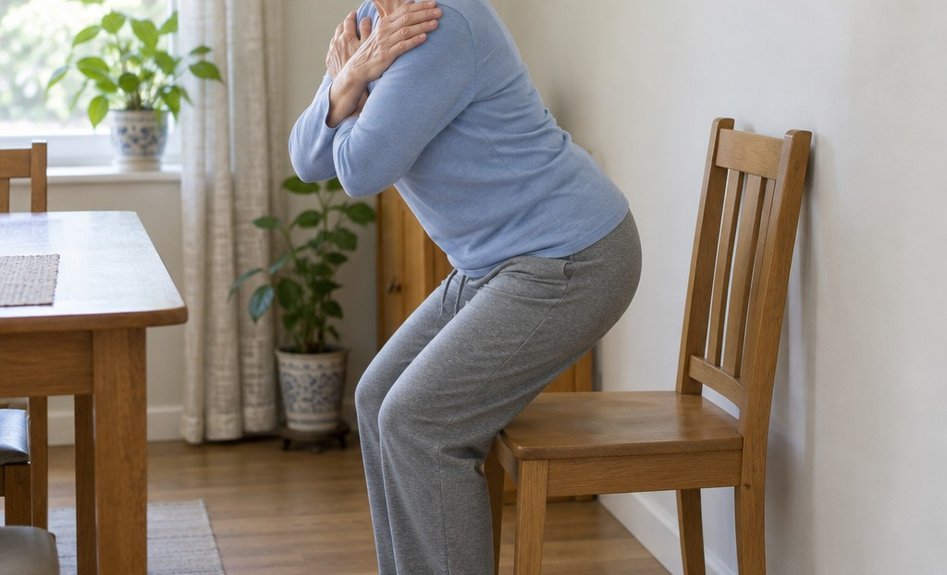
Set up first:
- A sturdy chair with a straight back and no armrests. The CDC version uses a seat about 17 inches high, close to a standard dining chair.
- Push the chair back against a wall so it cannot slide.
- A phone timer, or a clock with a second hand.
- Someone standing beside you if your balance is shaky. The CDC’s own instructions ask the tester to stand next to the person.
Then follow the CDC’s steps:
- Sit in the middle of the seat, feet flat on the floor.
- Cross your arms at the wrists, hands on the opposite shoulders.
- Keep your back straight and your arms against your chest.
- On “go,” stand all the way up, then sit all the way back down.
- Repeat for 30 seconds and count each full stand.
If you are more than halfway up when the 30 seconds end, that stand counts.
If you need your arms to get up, stop the test. On the CDC form that is a score of zero, and it simply marks your starting point.
This is general information, not medical advice. If you get dizzy, have fallen recently or have a new hip or knee, ask your doctor or physical therapist first.
What your number means for your age
The CDC’s 30-second chair stand form lists these below-average scores:
- 60–64: fewer than 14 for men, fewer than 12 for women
- 65–69: fewer than 12 for men, fewer than 11 for women
- 70–74: fewer than 12 for men, fewer than 10 for women
- 75–79: fewer than 11 for men, fewer than 10 for women
- 80–84: fewer than 10 for men, fewer than 9 for women
- 85–89: fewer than 8 for both men and women
- 90–94: fewer than 7 for men, fewer than 4 for women
Here is how to read it.
A 72-year-old woman who stands 9 times is under the line of 10 for her age group. At 10 or more, she would be at or above it.
The form says a below-average score indicates a risk for falls. Read a low score as a reason to start strength work, and as something to mention at your next checkup.
It is one short test, not a full assessment. A doctor or physical therapist can look at balance, walking and medicines as well.
How to raise your score
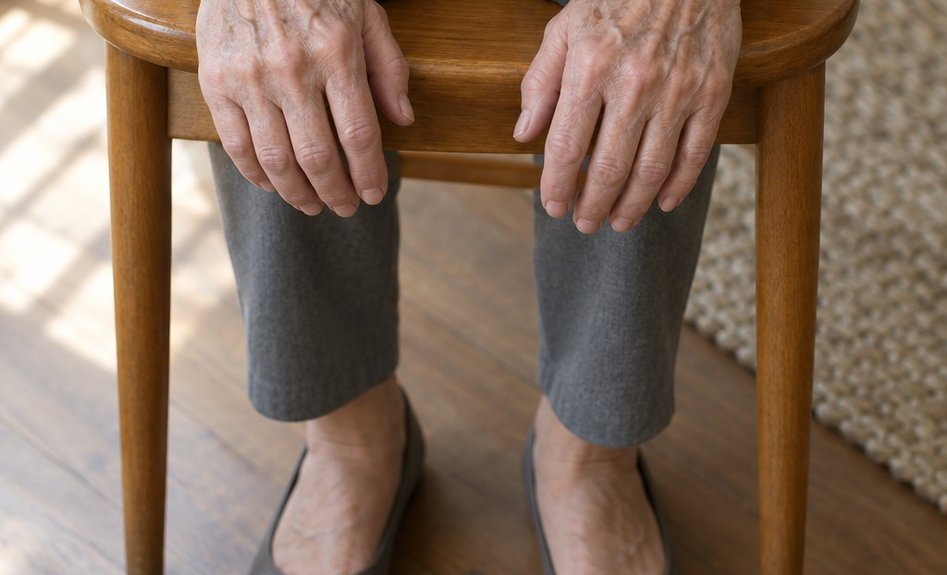
The fix is the test itself, done as practice. The CDC’s chair rise exercise uses the same movement, with one difference that makes it easier to begin.
In the practice version you may rest your hands lightly on the seat, and the goal is to need them less over time.
- Sit toward the front of the chair, knees bent, feet flat and shoulder-width apart.
- Rest your hands lightly on the seat beside you.
- Lean forward so your weight moves onto the front of your feet.
- Breathe out and stand up slowly, using your hands as little as you can.
- Pause for a full breath, then sit down slowly without dropping into the seat.
The CDC sheet suggests 10 to 15 repetitions, a minute of rest, then a second set of 10 to 15. If that is too many at first, start with fewer and build up.
The slow lowering matters as much as the standing up.
Controlling the sit is what keeps you from dropping onto a chair, a car seat or a toilet.
For more ways to work the same muscles, these chair exercises for building strength start seated and need no equipment.
Adults 65 and older are advised to do muscle-strengthening activity at least 2 days a week, so twice a week is a sensible first target.
Leg strength and steadiness work together. If your score was low, add some of the moves from the research on balance training and falls as well.
When to test again
Use the same chair, the same spot and the same time of day each time, so the numbers compare fairly.
Retest after six to eight weeks of practice, not every few days. Strength builds slowly, and a count taken every day can reflect tiredness as much as strength.
Your grip is another quick check of the same thing, and what grip strength says about aging covers how to read it.
Write today’s count and the date on your calendar, and test again in eight weeks with the same chair.