

Walking is one of the simplest things you can do for your health. You need no equipment, no membership and no special skill.
Regular brisk walking helps your heart, your mood and your sleep, and it is gentle on your joints. Here is what research says about each.
How Does Walking Help Your Heart?

A meta-analysis covering 295,177 people found that about 30 minutes of normal walking a day, five days a week, went with 19% lower risk of coronary heart disease.
A second meta-analysis compared the most active walkers with the least active. The pooled hazard ratio for cardiovascular disease in the highest walking group was 0.69, roughly a third lower.
About 30 minutes of walking on most days goes with a lower risk of heart disease.
Regular walking can also help lower blood pressure. For the numbers behind a daily goal, see how much walking you need.
Can Walking Ease Stress and Improve Sleep?
Many people find a walk clears the head and eases worry. The research points the same way.
A 2025 review linked about 7,000 steps a day to a 22% lower risk of depressive symptoms, compared with 2,000 steps. That is an association, not proof.
A review of 86 trials found that aerobic exercise, strength training and gentler options all improved sleep quality. Walking is an easy form of aerobic exercise.
A daily walk can lift your mood and help you sleep. Try going outdoors and noticing what is around you.
What Does Walking Do for Your Joints and Bones?
Walking keeps your joints moving and the muscles around them working. It is also weight-bearing, which is the kind of activity bones respond to.
Walking is a low-impact choice. In a lab study, the force on the foot was about 1.2 times body weight in walking. It reached about 2.5 times at the fastest running speeds tested.
Running carries more injury risk. A systematic review of running injuries found an overall incidence of about 40%, most often at the knee, ankle and lower leg. For more on staying injury-free, see how to prevent common exercise injuries.
Pairing walks with exercises for stronger bones gives your skeleton more to work with.
Walking is a gentle way to keep joints and bones working. If a joint aches as you go, these exercise modifications can help you keep walking.
If you have osteoporosis, arthritis or a joint replacement, ask your doctor which surfaces and distances are safe for you.
Is Walking as Good as Running?
At the same energy cost, walking protected as well as running in large studies. You don’t have to run. You just have to move.
The National Runners’ and Walkers’ Health Study followed 33,060 runners and 15,945 walkers for about six years.
Compared at equal energy expenditure, walking and running produced similar risk reductions for high blood pressure, high cholesterol and diabetes, and possibly heart disease.
A New England Journal of Medicine study followed 73,743 women aged 50 to 79. Walking and vigorous exercise were associated with similar reductions in heart disease risk.
If you already enjoy jogging, you don’t have to stop. If you have arthritis, a past injury or a joint replacement, ask your doctor or physical therapist whether walking or running suits you.
Why Walking Is Easy to Keep Doing
The best exercise is the one you keep doing, and walking is easy to keep. Records from one fitness center in Brazil show how hard gyms can be to stick with.
Among its new members, 63% quit within three months, and fewer than 4% stayed active for 12 months.
Walking needs no equipment, no commute and no class schedule. A review notes that walking has been found to promote better adherence than more intense exercise.
If you’re getting started, how to start exercising after 50 shows how to build a routine that sticks. When the weather turns, these tips for staying active through the cold winter months keep it going.
Can Walking Help With Weight?
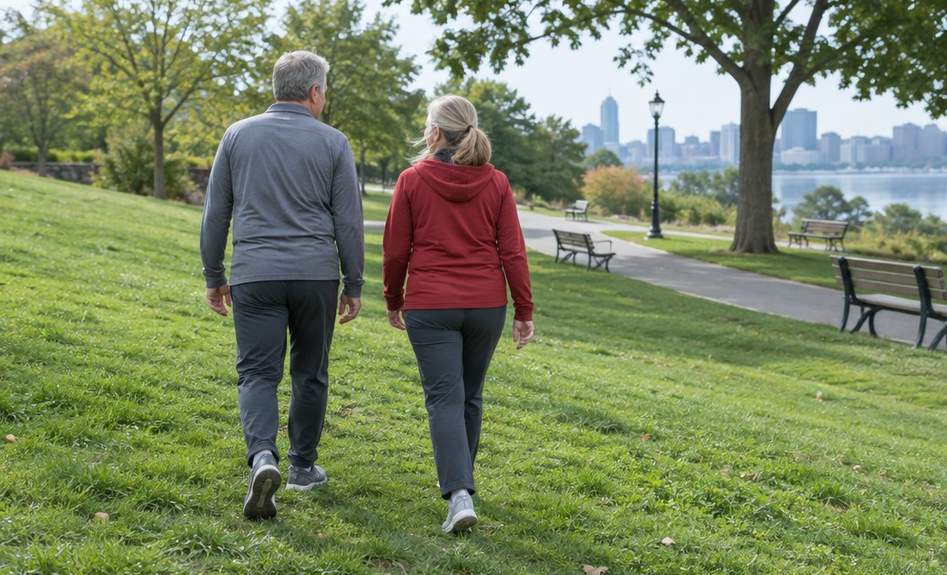
Walking burns calories, and it builds the habit of moving. For weight, what you eat matters too.
Think of walking as a steady habit for weight, not a quick fix.
You can walk almost anywhere, at any time. A pair of comfortable walking shoes makes it easier to keep going.
How Much Walking Do You Actually Need?
The usual guideline is at least 150 minutes of moderate activity a week. In a pooled analysis of 661,137 people, meeting that minimum went with a 31% lower risk of death than no activity.
Less than that went with a 20% lower risk.
Aim for about 150 minutes of brisk walking a week, and break it into pieces if that suits you. That is about 30 minutes on five days.
The American Cancer Society reports that 2.5 to 5 hours of moderate activity a week was linked to lower risk for seven cancers. Brisk walking counts.
If you prefer counting steps, the 10,000 steps goal page explains why a lower number works.