

Two bands are enough to start: a light one for everyday use and a medium one for when the light band gets easy. A set that includes both covers most beginners.
Band colors differ from brand to brand, so read the tension label instead of trusting the color. Choose a light band first, and move up only when your exercises feel easy.
Which Resistance Band Type Should You Actually Buy?
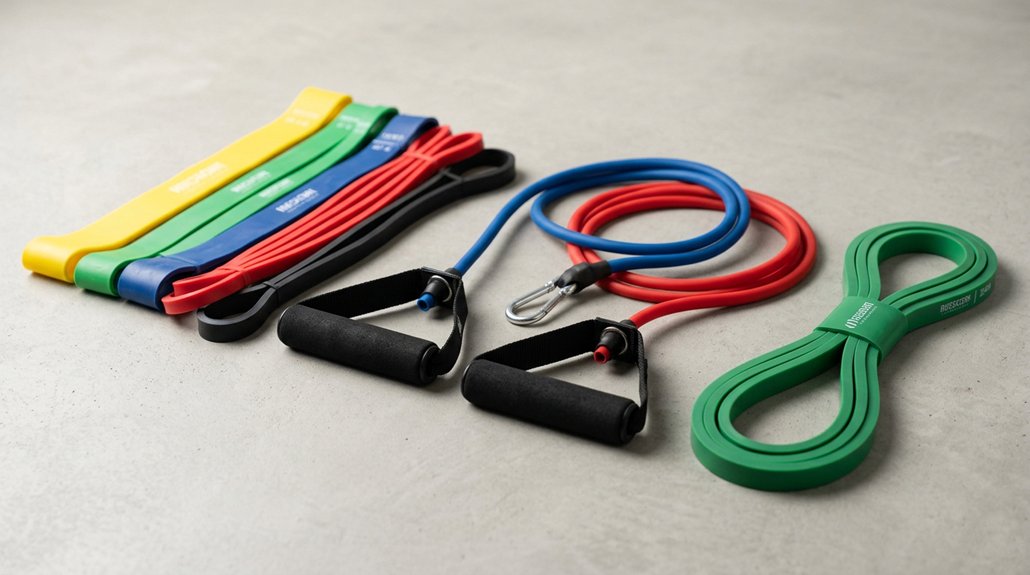
Pick the band shape that fits the exercises you plan to do. Each type suits different exercises.
Long flat bands work for full-body moves such as squats and rows. Handled bands suit upper-body work such as bicep curls and shoulder presses.
Loop bands are good for lower-body exercises such as glute bridges and side steps.
A set with several levels lets you change the tension by muscle group. Legs usually need more than arms.
Sets built for beginner-friendly home strength training typically include several levels, so you can progress without buying again.
How to Choose the Right Resistance Band Level Without Guessing
The right band lets you finish every repetition with good form while your muscles feel the work. If you can’t control the movement, the band is too strong.
Harvard Health suggests eight to 12 reps per set for its band leg exercises. Use that as a guide for your first sessions.
Begin with a light band. Move to a medium one when the last reps of a set feel easy and you can still keep your form.
If you are recovering from an injury or surgery, ask your doctor or a physical therapist which band and exercises are safe for you.
You can compare light resistance bands on Amazon for gentle strengthening while you build a base.
Some links on this page go to Amazon, and the site earns a small commission when a reader buys through one.
What Should Your Beginner Resistance Band Set Include?
A beginner set should include at least two tension levels, so you can progress without hitting a wall.
- A light band for foundational exercises such as squats and bicep curls.
- A medium band to move up to when the light one feels easy.
Several tension levels let you match each exercise to a muscle group. Progress at your own pace, because there is no deadline.
When you shop, compare resistance band sets on Amazon and look for bands with a printed tension label. That makes it easier to track progress.
How to Spot a Band That Won’t Break Under Use

Check every band for damage before each use, and replace any band that shows a nick or crack. A small tear can grow under tension and snap.
Look for smooth, even material with no cracks. Natural latex and synthetic rubber both stretch well and spring back.
If you have a latex allergy, choose a latex-free band. MedlinePlus notes that latex-free versions of these products are available.
Keep bands out of the sun and away from sharp objects such as rings, because heat and nicks wear them out. A well-cared-for band lasts a long time.
You can compare resistance bands on Amazon and check the product details for the material.
The Quick Test for Your Resistance Band Fit
Test a new band with the exercise you plan to do, and stretch it only as far as the movement needs. Never pull it to its limit.
Anchor it securely and keep it away from your face. Stand with room around you in case it slips.
Do a set of eight to 12 repetitions. They should feel like work by the end, but your form should stay smooth.
If you finish 12 reps easily, the band is probably too light. If your form breaks down before eight, it is too strong.
Good form is also the best way to prevent common exercise injuries and to work the muscles you mean to.