
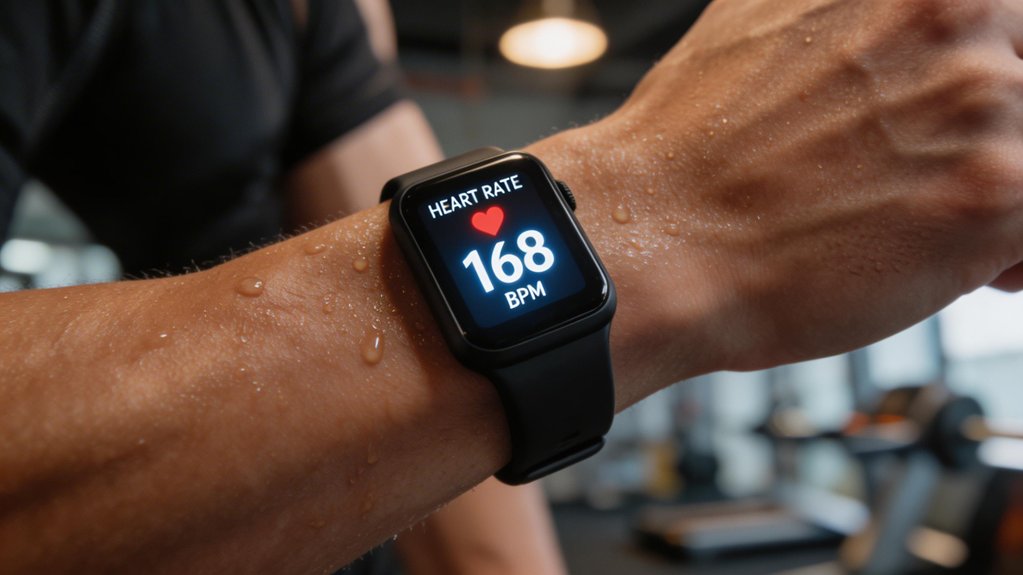
Your target heart rate is the safe zone where your heart should beat during exercise, typically 50-85% of your maximum heart rate.
To find yours, subtract your age from 220, then multiply by your intensity level. For a 40-year-old, that’s 90-153 beats per minute.
Staying in this range strengthens your cardiovascular system while preventing overtraining injuries like stress fractures.
Check your pulse within five seconds after exercising by counting beats for ten seconds and multiplying by six.
Understanding these specifics helps you exercise smarter and achieve better results.
What Your Target Heart Rate Actually Means
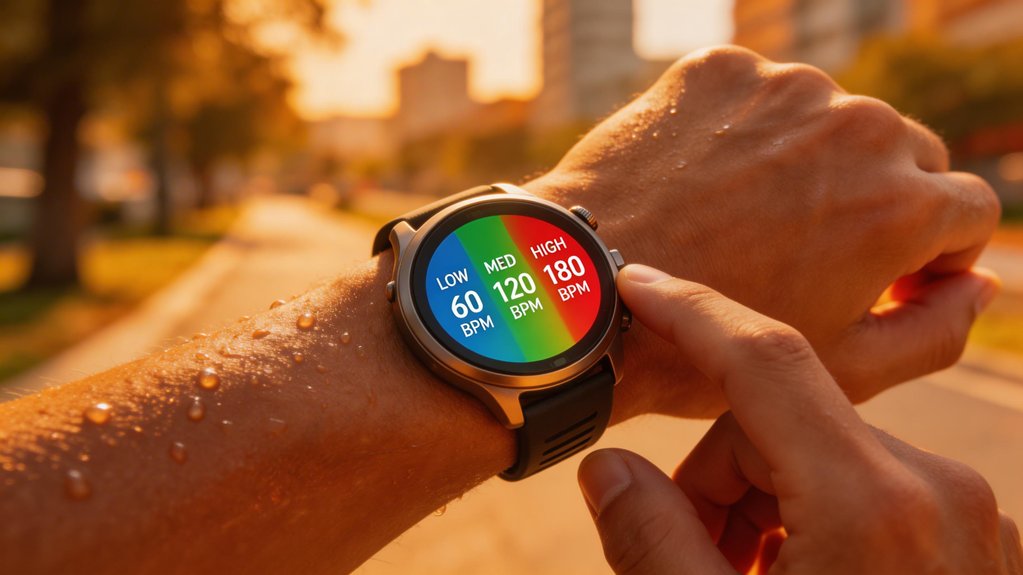
When you exercise, your heart needs to work hard enough to strengthen itself, but not so hard that you risk injury or burnout.
Your target heart rate is that perfect middle ground. It’s expressed as a percentage of your maximum safe heart rate, typically between 50-85%.
Working within this zone gives you real heart rate benefits while maximizing exercise efficiency. You’re conditioning your cardiovascular system without overdoing it.
Think of it as your body’s sweet spot, challenging enough to build fitness, sustainable enough to maintain consistently. This balance guarantees you’ll actually stick with your routine and see meaningful results.
Consistent exercise at your target heart rate also improves sleep quality, allowing your body to recover properly between workouts.
Calculate Your Target Heart Rate in 10 Seconds
Subtract your age from 220. This gives you your maximum heart rate. Next, understand percentages by multiplying that number by 0.50 and 0.85.
These calculations create your target zone range. A 40-year-old would calculate 220 minus 40, equaling 180 beats per minute maximum.
Then multiply 180 by 0.50 for 90 beats per minute (lower zone) and 180 by 0.85 for 153 beats per minute (upper zone).
You’ve now calculated your personalized target range in seconds. This knowledge helps you exercise effectively and safely every workout.
You can monitor your exercise intensity throughout your workout without needing any special equipment by checking your pulse during exercise.
How Staying in Your Target Zone Prevents Overtraining Injuries
Now that you’ve calculated your personalized target zone, you’re ready to understand why staying within it matters so much.
Pushing beyond your upper limit creates serious overtraining risks. Your body needs recovery time between workouts to adapt and strengthen.
When you exceed 85% of maximum heart rate consistently, you invite injury prevention challenges like tendinitis, stress fractures, and burnout.
Staying in your zone lets you build endurance safely. You’ll condition your cardiovascular system without overwhelming it.
Regular aerobic exercise within your target zone also triggers BDNF production, which supports brain health and neuroplasticity as you age.
This balanced approach means you can exercise regularly without sidelining yourself with preventable injuries.
Find Your Target Heart Rate Zone by Activity Type

Different exercises’ll put your heart to work in different ways, so your target zone might shift depending on what you’re doing.
Cardio activities like running pace typically push you toward 70-85% of your maximum heart rate. Cycling intensity varies: stationary biking sustains around 75% for thirty minutes.
Running and cycling push your heart rate to 70-85% and around 75% respectively, maximizing cardio benefits.
Swimming efficiency often lands you at 60-70% because water supports your body weight. Strength training keeps you near 70% of your upper limit.
Yoga benefits come from lower zones, around 50-60%, making it accessible for building endurance.
Beginners often do best with low-impact exercises like swimming and yoga, which reduce stress on joints while still providing effective cardiovascular benefits.
You’re fundamentally matching your zone to each activity’s demands, helping you serve your fitness goals effectively.
How to Monitor Your Target Heart Rate During Exercise
Two simple methods’ll get you an accurate heart rate reading during your workout.
Stop exercising and check your pulse within five seconds; your heart rate drops immediately when you stop moving. Count your pulse for ten seconds, then multiply by six for beats per minute.
Alternatively, count for fifteen seconds and multiply by four. These quick measurements help you monitor heart rate variability and track exercise recovery between sessions.
Different activities produce varying responses; weight training typically reaches seventy percent of your maximum, while stationary biking might hit seventy-five percent.
Regular monitoring guarantees you’re working at the right intensity for your fitness goals.
For more precise tracking during your workouts, consider investing in one of the available heart rate monitors for exercise on the market today.
References
- https://uihc.org/health-topics/target-heart-rate-exercise
- https://www.brownhealth.org/be-well/target-heart-rate-zones-safely-maximize-your-workouts
- https://www.hopkinsmedicine.org/health/wellness-and-prevention/understanding-your-target-heart-rate
- https://www.mayoclinic.org/healthy-lifestyle/fitness/in-depth/exercise-intensity/art-20046887
- https://medlineplus.gov/ency/imagepages/18138.htm
- https://www.brighamandwomens.org/patients-and-families/meals-and-nutrition/bwh-nutrition-and-wellness-hub/your-target-heart-rate
- https://www.allinahealth.org/health-conditions-and-treatments/health-library/patient-education/helping-your-heart/healthy-living/exercise/measuring-how-your-heart-reacts-to-exercise
- https://www.urmc.rochester.edu/encyclopedia/content?contenttypeid=1&contentid=682
- https://www.heartonline.org.au/resources/calculators/target-heart-rate-calculator
This is general information about exercise and health research, not medical advice.