

If you prefer exercising alone, you’re in good company. Plenty of people do.
But research shows that solo exercisers are significantly more likely to quit than people who work out with others.
A 2024 systematic review found that 83% of group-based programs beat their adherence expectations, against 50% of those done individually. That review covered exercise programs for people with overweight or obesity, so the exact gap may differ elsewhere.
That’s not a small gap. And it has nothing to do with personality.
Human psychology and physiology respond differently to social context.
Motivation, effort output and even pain tolerance change measurably when you exercise alongside someone else.
You don’t have to enjoy group settings for these effects to kick in. They’re biological responses, not social preferences.
Why We Stick With Exercise Longer When Others Are Involved
Commitment devices are a key concept in behavioral science.
When you tell someone you’ll meet them for a walk, you’ve made a social promise. Breaking it carries a real cost.
That cost, small as it is, gets you out the door on days when nothing else would.
Community-based group exercise programs show an overall mean adherence rate of 69.1%, according to a review in Preventive Medicine. That’s meaningfully higher than solo programs tracked over similar timeframes.
Social support from others is one of the strongest predictors of long-term exercise attendance in peer-reviewed research.
That support doesn’t require a class or a gym. One neighbor who expects to see you at 7am works just as well.
There’s also an identity shift that happens over time.
People who exercise with others tend to develop a stronger exercise identity. They start to see themselves as people who exercise regularly.
That shift in self-perception is one of the most durable predictors of long-term habit formation. Solo exercisers often miss out on this reinforcement. There’s no one to reflect it back to them.
Community-based group exercise programs show an overall mean adherence rate of 69.1%, meaningfully higher than solo programs tracked over similar timeframes.
How Social Context Changes Performance and Effort
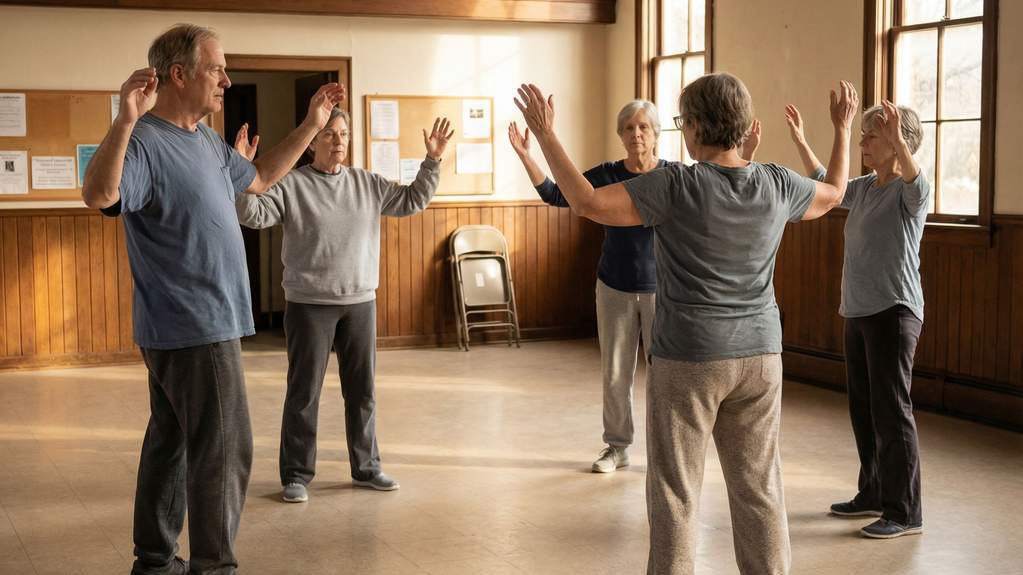
Social facilitation is one of psychology’s oldest findings. People perform better on familiar physical tasks when others are present.
A 2022 systematic review and meta-analysis in the International Review of Sport and Exercise Psychology confirmed this effect in modern exercise settings.
Here’s something that might surprise you.
When people exercise with someone slightly fitter than them, they don’t coast. They work harder.
Researchers have a name for this: the Kohler effect, first observed with rowing athletes in the 1920s.
The mechanism is simple. No one wants to be the one who gives up first.
People perform better on familiar physical tasks when others are present.
A 2023 meta-analysis in Kinesiology Review examined 19 studies with a combined sample of 1,912 participants. It found a statistically significant motivation gain in partnered exercise compared to exercising alone.
The boost was strongest when participants were the slightly weaker member of the pair.
You don’t have to be competitive for this to work. It’s not about winning. It’s about not wanting to let the other person down.
Social context also changes how long people endure discomfort.
Compared to solo exercise, synchronous group exercise leads to higher post-workout pain thresholds. People push harder when others are present.
The underlying mechanisms include social comparison, accountability, and endorphin release triggered by synchronized movement. You don’t need to understand the science for it to work.
A 2023 meta-analysis in Kinesiology Review found a statistically significant motivation gain in partnered exercise compared to exercising alone across 19 studies and 1,912 participants.
The Different Ways Social Exercise Works
The social effect appears across many formats, including ones that cost nothing.
- Walking with a neighbor is one of the most accessible starting points. Research consistently identifies social connectedness and shared identity as the top drivers of adherence in walking interventions. If you want to understand just how much the Benefits of Walking for Overall Health stack up, the case is strong. Adding a walking partner makes it far more likely you’ll keep going.
- Mall walking groups and park meetup groups are another option. They’re often free and open to all fitness levels. These informal communities carry the same psychological benefits as formal classes: accountability, shared identity, and the mild social pressure of showing up for someone else.
- Group fitness classes show strong results too. Research on group exercise membership found that exercising with a group of at least 12 was linked to greater satisfaction and more frequent activity. Participants also reported higher self-perceived health overall.
- Virtual communities also work. A study published in Physical Activity and Health found meaningful differences in motivation. People who took virtual fitness classes with social presence reported higher motivation than those who exercised alone online.
Your accountability partner doesn’t need to be in the same room.
Even minimal social context shifts behavior:
- A shared step challenge at work
- A group text where someone checks in weekly
- An online forum where people post their workouts
These informal connections change exercise behavior in measurable ways.
For introverts: the research benefits are not limited to people who love being around others. The pull of not wanting to let someone down, the lift from others being present, the social promise of showing up. These mechanisms activate regardless of personality type.
Making Social Exercise Work For You
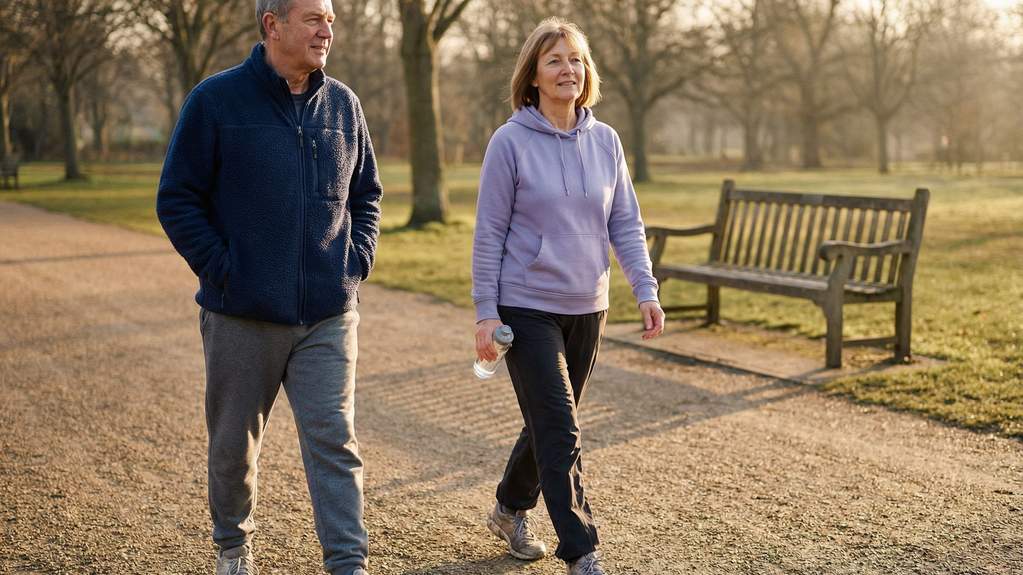
One change is enough to start.
Ask one person you trust to walk with you once a week. That single commitment consistently improves adherence in the research.
If you are not sure where to begin, there are practical first steps in How to Start Exercising After 50.
Small, consistent effort produces real results. Adding one other person to that effort makes consistency significantly more likely.
If you’ve struggled to stay on track exercising alone, this is worth knowing. The research on How to Stay Motivated to Exercise Regularly consistently points to social accountability as one of the most effective tools available.
If getting outside feels like a barrier, virtual options are a fully valid starting point.
Online accountability groups, fitness apps with community features, and live-streamed classes all activate the same psychological mechanisms as in-person exercise.
The lowest possible starting point: text one person today and ask if they want to walk this week.
The Case for Not Going It Alone
Solo exercise isn’t wrong. Plenty of people maintain healthy routines working out independently, and any movement is better than none.
But the science is clear.
Humans perform differently in social contexts. More effort, more endurance, more consistency, more follow-through.
These are documented physiological and psychological responses. Not personality traits.
What this body of research says is that adding even one person to your exercise routine isn’t a shortcut.
It’s a strategy. One with measurable, documented advantages that work regardless of who you are.
Read more: How Regular Exercise Changes Your Mood