
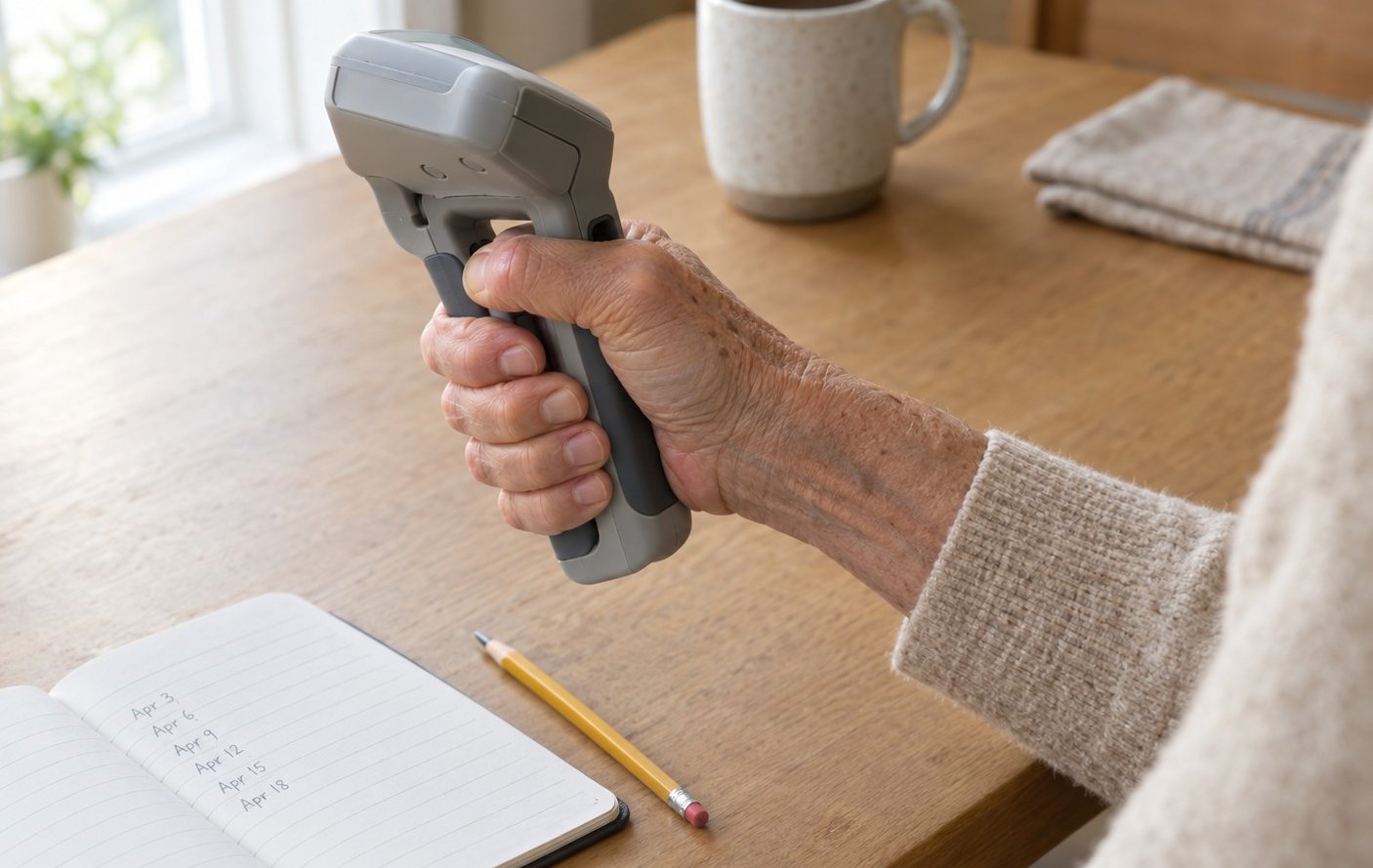
The display settles on 50, and you wonder whether that is a good number. For a 68-year-old woman, 50 lb (23 kg) is about the 15th percentile: below most women her age, with room to improve.
It is also well above the weak-grip line of 35 lb (16 kg).
Grip holds up fairly well through the 50s and 60s, then the drop speeds up after 70. Fewer than 2 in 100 adults are below the weak-grip line in their 60s. At 80 and over, about 1 in 5 are.
How strong is the average grip at your age?
The median woman in her 60s squeezes 60 lb (27 kg). The median man in his 60s squeezes 96 lb (44 kg). Half of people your age and sex score higher, and half score lower.
These numbers come from our analysis of grip tests in the National Health and Nutrition Examination Survey. CDC, the US government’s public health agency, runs it.
We used the 2011-2012 and 2013-2014 rounds, the most recent national grip data: 6,327 adults aged 40 and over. Each person’s score is the best of six squeezes, three with each hand.
Women: best-hand grip strength by age
| Age | Median, lb (kg) | Middle half, lb |
|---|---|---|
| 40 to 49 | 69 (31) | 62 to 77 |
| 50 to 59 | 65 (29) | 58 to 72 |
| 60 to 69 | 60 (27) | 53 to 66 |
| 70 to 79 | 53 (24) | 46 to 60 |
| 80 and over | 42 (19) | 36 to 50 |
Men: best-hand grip strength by age
| Age | Median, lb (kg) | Middle half, lb |
|---|---|---|
| 40 to 49 | 108 (49) | 97 to 121 |
| 50 to 59 | 102 (46) | 91 to 112 |
| 60 to 69 | 96 (44) | 84 to 108 |
| 70 to 79 | 86 (39) | 73 to 95 |
| 80 and over | 72 (33) | 61 to 82 |
The middle half is the 25th to 75th percentile: half of people that age score inside it.
The median falls slowly at first, then faster. Women lose about 4 to 5 lb per decade from the 40s to the 60s.
That grows to about 6 lb from the 60s to the 70s, and 11 lb from the 70s to 80 and over.
Men follow the same shape. They lose about 6 lb per decade to the 60s, 10 lb to the 70s, and 14 lb to 80 and over.
Men Women. Line: median. Shaded band: 10th to 90th percentile.
At 80 and over, the median is 42 lb (19 kg) for women and 72 lb (33 kg) for men. A woman at 80 who squeezes 50 lb is above the median for her age group.
How many people fall below the weak-grip line?
The weak-grip line is a best squeeze under 60 lb (27 kg) for men and under 35 lb (16 kg) for women.
It comes from the European Working Group on Sarcopenia in Older People, a panel of muscle-health specialists. Sarcopenia means age-related loss of muscle.
In their consensus, a squeeze below the line is the first sign of probable sarcopenia, and it starts further checks rather than a diagnosis.
Here is how many people fall below it:
- 40s to 60s: fewer than 2 in 100 for both sexes.
- 70s: about 5 in 100 (5.9% of men, 4.5% of women).
- 80 and over: about 1 in 5 (20.1% of men, 21.7% of women).
Men, below 60 lb (27 kg) Women, below 35 lb (16 kg)
A weak grip is uncommon before 70. After 80, it is common enough that you should know your number.
Where does your number fall?
Enter your sex, your age and your best squeeze, in pounds or kilograms. The calculator returns your percentile and the median for your age group.
Where does your grip fall?
Use your best single squeeze from either hand.
Compares you with US adults your age and sex in CDC’s national survey (2011 to 2014).
You squeeze harder than about this many people your age and sex
An estimate from survey percentiles, most reliable between the 10th and 90th. A different device or position can read differently.
At the 25th percentile, you squeeze harder than 25 in 100 people your age and sex.
Take the 68-year-old woman at 50 lb again. She falls between the 10th percentile (48 lb) and the 25th (53 lb) for women in their 60s, at about the 15th.
The tables group ages by decade, so at 67 or 68 you are compared with women as young as 60.
Grip falls a little each year. A number near the top of a decade reads slightly lower than it would against women exactly your age.
A man in his 60s at 84 lb (38 kg) is at the 25th percentile. The median for his group is 96 lb (44 kg).
How do you test grip at home the way the survey did?
If your number came from a clinic, ask how it was taken. The tables use the best single squeeze, and the survey tested people standing.
An average of three squeezes, or a test done sitting, can come out a little different, so compare it with the tables loosely.
To track your own number at home, you need a hand dynamometer, a small device that shows how hard you squeeze. You can compare hand dynamometers on Amazon.
Copy the survey's routine, and your number compares more closely with the tables above:
- Set the grip size. Adjust the handle so your fingers wrap around it comfortably.
- Practice once. Do one squeeze first, to learn how the device feels.
- Stand up. Sit only if standing is hard for you.
- Squeeze hard. Squeeze as hard as you can while breathing out.
- Alternate hands. Do three squeezes with each hand, switching between them.
- Rest between squeezes. Wait 60 seconds before using the same hand again.
- Record your best. Write down the single highest reading from either hand.
Skip a hand that had surgery on the hand or wrist in the last three months. The survey did the same.
Three limits apply to the comparison:
- The survey ran from 2011 to 2014.
- Home devices can read differently from each other, so compare your own results on one device only.
- People who could not hold a dynamometer in either hand were not tested. This may leave out some of the weakest people.
We checked our method for ages 60 and over. Computed the way a published study did it, our numbers come within about 1.5 kg (3 lb) of its averages from the same survey.
What does a low grip number mean?

A number below the weak-grip line is a reason to talk with your doctor. In the consensus above, it starts further checks of muscle and physical performance.
Even above the line, mention a clear drop between two tests at your next checkup.
A low percentile is not the same as being below the line. The 68-year-old woman at 50 lb has room to improve, and is above the weak-grip line. In the consensus, exercise training seems to slow or reverse muscle loss.
If you already see a physical therapist, ask them to retest you the same way after six to eight weeks of strength work.
Grip strength is moderately linked to strength elsewhere in the body, so doctors use it as a quick check. The research behind that is in what your grip strength reveals about aging.
What should you do next?
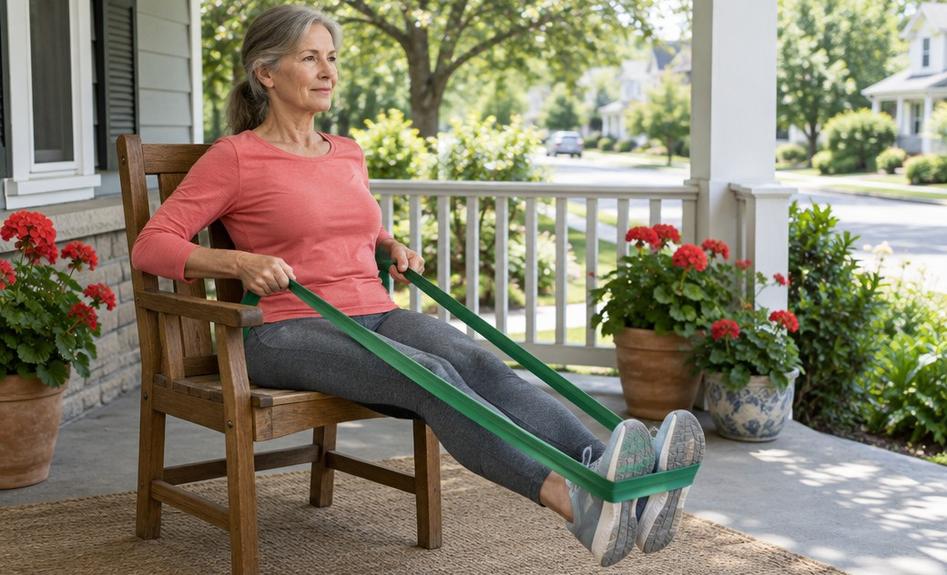
Adults 65 and older need muscle-strengthening activity at least 2 days a week, according to CDC. That means work for all the major muscle groups, not only the hands.
Start with strength training for beginners. A quick second check of your leg strength is the chair stand test. If you want a trainer for your hands, there is a guide to grip strengtheners.
Today, write down your best squeeze and the device you used. Add one strength session this week.
Then test again after six to eight weeks, under the same conditions: same device, same standing position, same time of day. Compare the new number with the old one.
Sources: CDC, NHANES grip strength documentation; Bohannon and others, American Journal of Occupational Therapy, 2019, grip strength reference values; Cruz-Jentoft and others, Age and Ageing, 2019, EWGSOP2 consensus; CDC, Physical activity guidelines for older adults.