
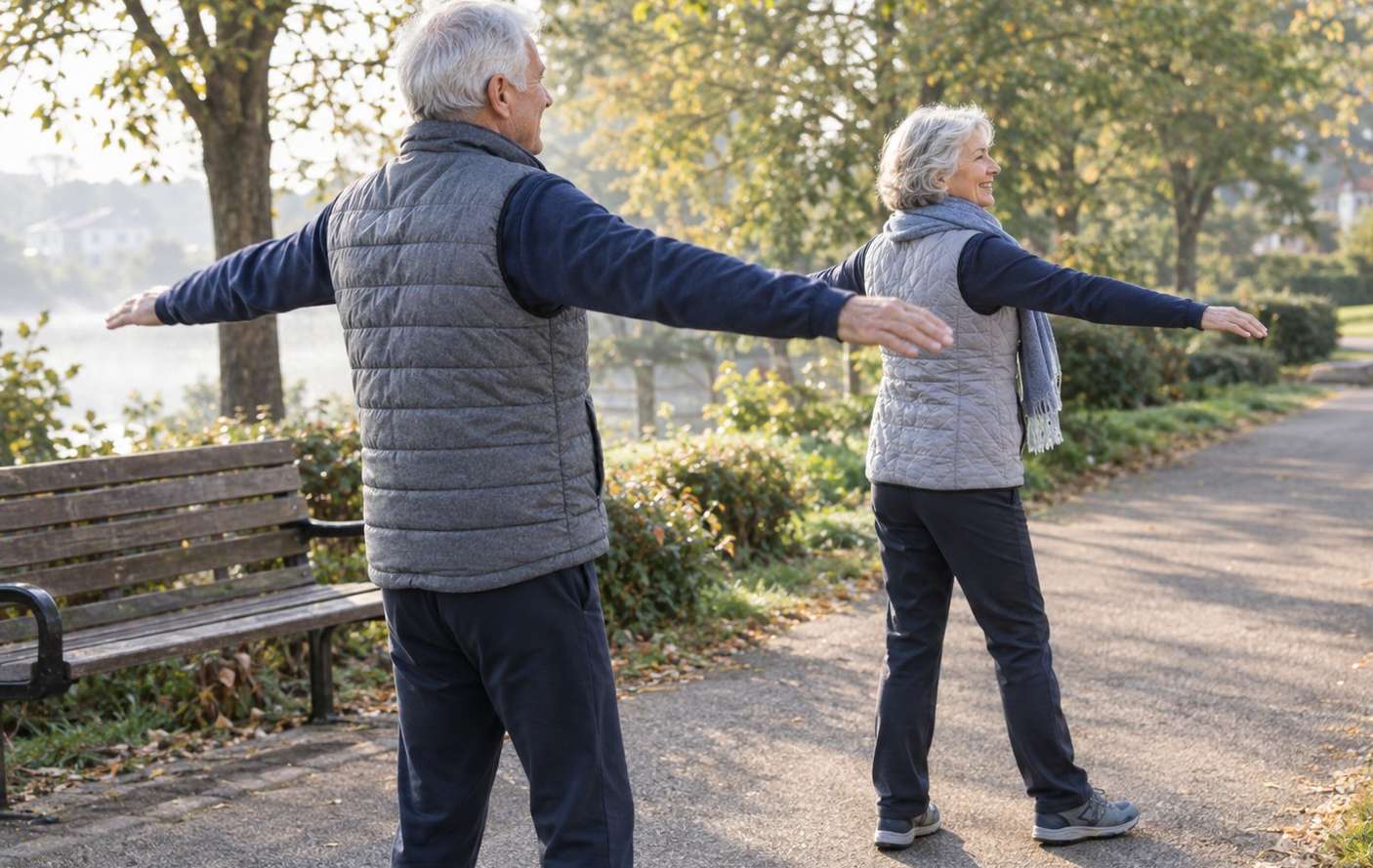
Mostly yes. Moving stretches (dynamic) go before you start, and held stretches (static) go afterward, but short static holds of under about 60 seconds before activity cost little in studies of active adults.
This is general information, not medical advice, so check with your doctor if you have concerns.
Dynamic and static stretching side by side
| Type | What it is, and when | Example |
|---|---|---|
| Dynamic | Moving a joint through its range, before activity (10 to 12 repetitions) | Leg pendulum |
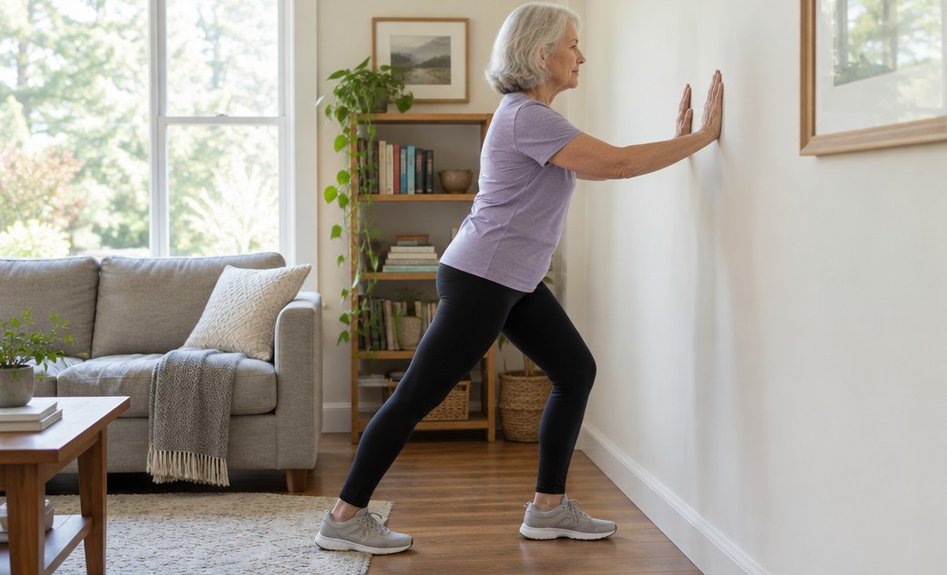
| Static | Holding a position, after activity (30 to 60 seconds for older adults) | Calf stretch |
Cleveland Clinic, a non-profit academic medical center, treats the two as very different techniques.
Dynamic stretching means actively moving your joints and muscles. The motions often copy the activity you are about to do.
Static stretching means moving a joint as far as it comfortably goes and holding it there.
A dynamic stretch moves a muscle through its full range without pushing it to the maximum. A static stretch holds the position still.
Harvard Health Publishing, the consumer health publisher of Harvard Medical School, says to hold it without bouncing. Bouncing can tear muscle fibers.
Two more types:
- Ballistic stretching is a faster, bouncing form of dynamic stretching. A 2018 review in Sports Medicine concluded it would be less beneficial than controlled dynamic stretching.
- PNF stretching is usually done with a partner. They push your limb into a stretch, you tense the muscle hard for five to 10 seconds, and they push a little further.
A 2012 review in the Journal of Human Kinetics noted that PNF is usually done with a maximal contraction. That can cause soreness or injury, and the review suggested PNF possibly should not be used with older people.
What the reviews found about stretching before activity
Most of this research pooled healthy, active adults and athletes. It measured strength, power, sprinting and jumping.
The performance reviews below do not report results for adults over 50.
- 2012, Medicine & Science in Sports & Exercise (106 studies): static holds under 30 seconds had no harmful effect. Holds of 30 to 45 seconds had no significant effect either. A real drop in performance was likely with holds of 60 seconds or more.
- 2016, Applied Physiology, Nutrition, and Metabolism (healthy active people): holds of 60 seconds or more per muscle group cut performance by 4.6 percent. Shorter holds cut it by 1.1 percent.
- 2019, Frontiers in Physiology: static holds of 60 seconds or less per muscle group changed strength and power by a trivial 1 to 2 percent. Longer holds changed them by 4 to 7.5 percent.
Dynamic stretching gave small to moderate gains when done within minutes of the activity. That is the finding of the 2016 review.
One 2024 meta-analysis of six studies looked at older adults. It measured stiffness, not performance.
Static stretching lowered the stiffness of muscles and tendons by a small amount. The effect was comparable to that in younger adults.
In practice, Cleveland Clinic suggests a pre-workout routine built on dynamic stretching with only a few shorter static stretches. It puts those at about 15 to 30 seconds each.
Whether stretching lowers your risk of injury is a different question.
On whether stretching prevents injuries, the short answer is that static stretching alone does not. That page points instead to dynamic warm-ups combined with neuromuscular training, studied mainly in athletes.
How long to hold, and how often
The American College of Sports Medicine (ACSM) gives older adults a longer hold than most adults. An exercise-science summary of its 2011 position stand, by a University of New Mexico researcher, lists:
- Hold: 30 to 60 seconds for older persons (10 to 30 seconds for most adults).
- Total time: 60 seconds of stretching per target muscle group.
- Repetitions: 2 to 4 of each stretch.
- Frequency: at least 2 to 3 days a week for the major muscle groups, and daily brings greater gains.
- Effort: to the point of slight discomfort or tightness in the muscle.
Harvard Health puts the same idea simply: hold at least 15 seconds, then repeat to reach a total of 30 to 60 seconds. It adds that most of the change in muscle length happens around 30 seconds.
The longer holds belong in a stretching session after activity, not in the last minutes before a sport, where the reviews above favor short ones.
Four dynamic moves for a warm-up
Take five to 10 minutes. Harvard suggests a fast-paced walk, or marching in place while swinging your arms, as the warm-up before any stretching.
- Leg pendulum. Stand next to a chair or wall for support. Shift your weight onto one leg and slightly bend that knee. Swing the other leg forward and backward like a pendulum, keeping it relaxed, and gradually increase the range. Do 10 to 12 swings, then switch legs.
- Small hip circles. Stand with your feet hip-width apart and your hands on your hips. Gently rotate your hips in a circle, from front to back, keeping the movement small and controlled. After several turns, switch direction.
- March on the spot. The NHS, the UK’s National Health Service website, starts its warm-up here. March, then march forwards and backwards. Pump your arms up and down in rhythm, with elbows bent and fists soft.
- Knee lifts. Stand tall and bring alternate knees up to touch the opposite hand. Keep your abs tight, your back straight and a slight bend in the supporting leg.
Four static stretches for afterward
Do these once your muscles are warm. None of them needs equipment, though some people use stretching tools and straps to reach further.
Hold each for at least 15 seconds, repeat, and aim for 30 to 60 seconds in total on each side.
- Calf stretch. Stand up straight and hold the back of a chair, or press your hands against a wall at shoulder height. Extend one leg straight back and press the heel to the floor. Let the front knee bend, and feel the stretch up the back of the lower leg.
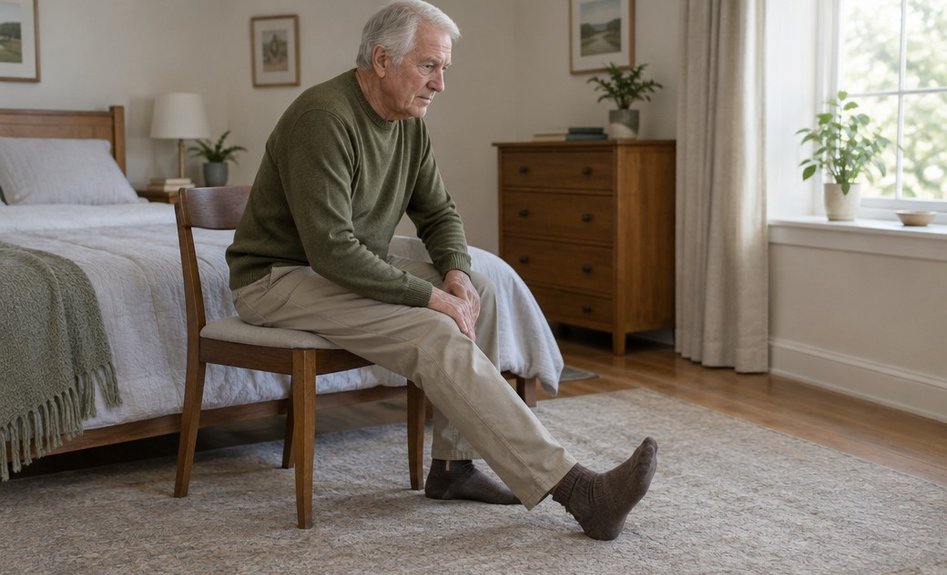
- Seated hamstring stretch. Sit up straight near the front of a chair, feet flat. Extend one leg in front with the heel on the floor and toes pointing up. Hinge forward from the hip, hands on the other thigh, and keep your spine neutral.
- Standing chest and shoulder stretch. Stand at arm’s length from a wall or doorway, facing away. Put one hand on the wall or door frame, slightly below shoulder level, palm forward. Slowly turn your body away until you feel the stretch in your chest and shoulder.
- Lying thigh stretch. The NHS gives this one a hold of 15 to 20 seconds. Lie on your side, grab the top foot and gently pull your heel toward your buttock. Keep your knees touching, then repeat on the other side.
Safety
You should feel tension during a stretch, never pain. Stop if it hurts, and do not bounce.
- Warm up first. Harvard says stretching muscles before they are warmed up can hurt them.
- Stretch to mild tension. The National Institute on Aging, part of the US National Institutes of Health, adds to remember to breathe.
- Even warm muscles can be strained by overstretching, Cleveland Clinic warns.
- With a damaged muscle or tendon, stretching can make the injury worse. After surgery, wait until your provider gives the go-ahead.
- With a condition such as Parkinson’s disease or arthritis, clear any new stretching routine with your doctor first.
Your next walk
Do the moving part first, for five to 10 minutes. Before your next walk, march on the spot, then do the leg pendulum and hip circles.
When you get back, do the calf stretch and the seated hamstring stretch. Hold each for 30 seconds and do it twice on each leg, which adds up to 60 seconds per muscle.