
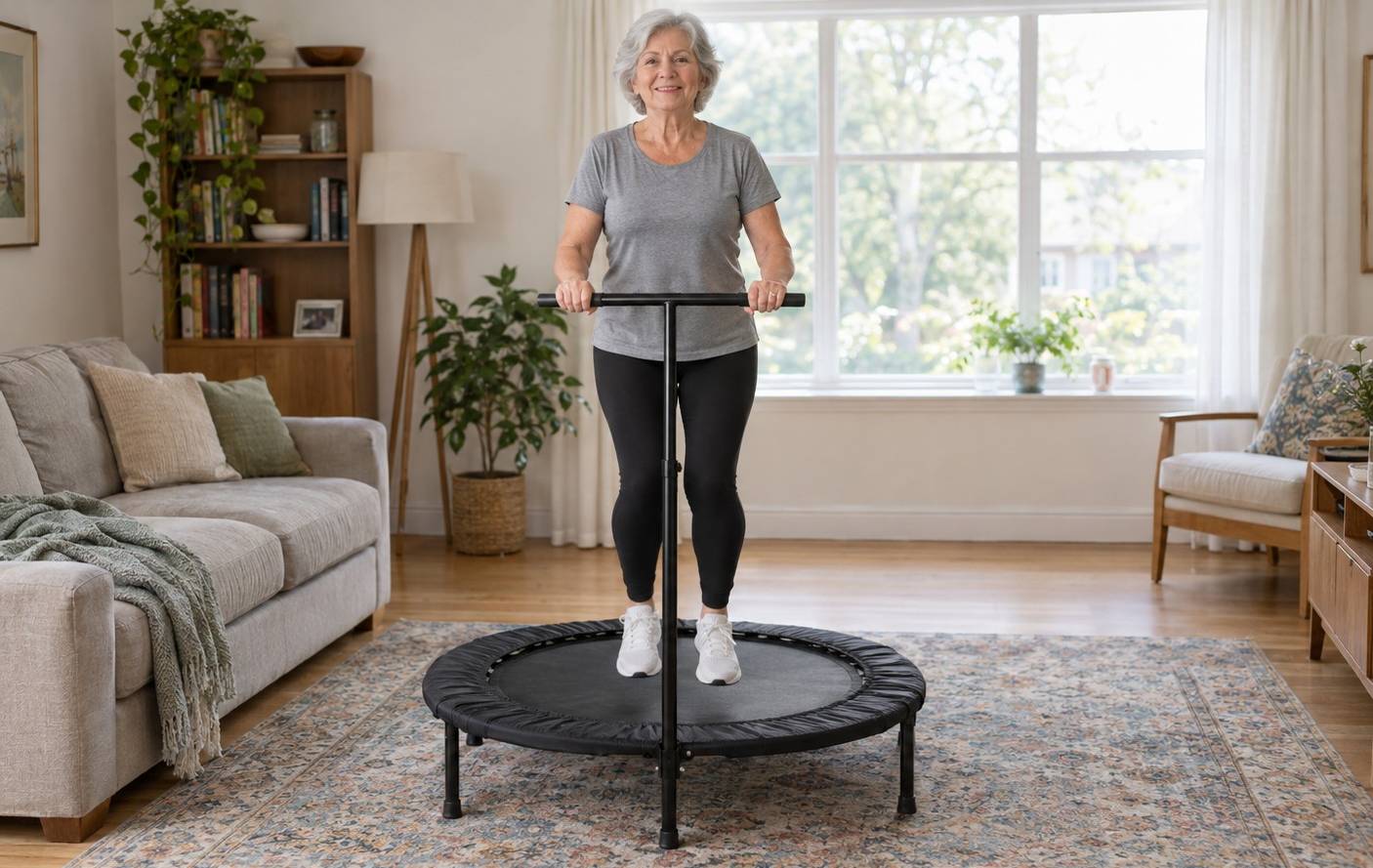
Choose the handle bar first, and start with the ZENOVA 40-inch. Its bar adjusts to four heights. They run from 32.7 to 41.7 inches on the mat.
A rebounder is a small trampoline for exercise at home. The bar gives you something to hold the whole time. This is general information, not medical advice, so check with your doctor if you have concerns.
Some links on this page go to Amazon, and the site earns a small commission when a reader buys through one.
The four rebounders, by handle height:
- ZENOVA 40-inch: handle 32.7 to 41.7 inches on the mat, springs, 330 lb limit.
- JUMPZYLLA: handle 32 to 42 inches, bungee cords.
- ANCHEER 40-inch: handle 30 to 41 inches on the mat, bungee cords.
- KOKSRY 50-inch: handle about 27.6 to 38.4 inches, springs, 450 lb limit.
Four rebounders with a bar to hold
ZENOVA 40-inch
You want the bar height measured from the mat and one clear weight limit
 ZENOVA 40 Inch Mini Trampoline with Adjustable Handle Bar
Handle 32.7 to 41.7 in on the mat
32 springs, 330 lb limit
See colors and prices on Amazon
ZENOVA 40 Inch Mini Trampoline with Adjustable Handle Bar
Handle 32.7 to 41.7 in on the mat
32 springs, 330 lb limit
See colors and prices on Amazon
ZENOVA lists four handle levels with a foam cover and gives the height against the mat. Its top setting, 41.7 inches, is the higher of the two bars that name the mat as the reference; ANCHEER’s tops out at 41.
The limit reads 330 lb in the title, the bullets and the details table alike. The frame uses 32 stainless steel springs, not bungee cords, and its six legs have anti-slip rubber.
It folds and comes with a 1-year warranty. Its assembly note asks you to be careful when you open and close the pad.
- Pass if
- You weigh more than 330 lb
JUMPZYLLA Mini Rebounder
You are tall and want a handle range that goes up to 42 inches
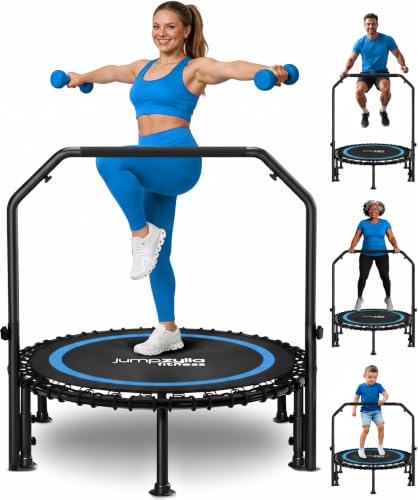 JUMPZYLLA Mini Rebounder Trampoline with Bar
Handle 32 to 42 in, four levels
Bungee cords, foldable
See colors and prices on Amazon
JUMPZYLLA Mini Rebounder Trampoline with Bar
Handle 32 to 42 in, four levels
Bungee cords, foldable
See colors and prices on Amazon
JUMPZYLLA lists a four-level foam-padded handlebar and latex bungee cords (elastic cords) where other rebounders use springs. The frame is galvanized stainless steel, and the mat is PP (a plastic).
Its top handle figure is the highest of the four. The listing does not say whether this is measured from the floor or the mat.
The rebounder folds and carries a 1-year manufacturer warranty.
ANCHEER 40-inch Foldable Mini Trampoline
You want bungee cords and a bar stated on the mat from 30 inches
 ANCHEER 40 Inch Foldable Mini Trampoline with Handle
Handle 30 to 41 in on the mat
32 bungee cords, six suction-cup legs
See colors and prices on Amazon
ANCHEER 40 Inch Foldable Mini Trampoline with Handle
Handle 30 to 41 in on the mat
32 bungee cords, six suction-cup legs
See colors and prices on Amazon
ANCHEER lists a foam handle with four height levels, 2 feet 6 inches to 3 feet 5 inches on the mat. That is the lowest bottom setting of the two bars that name the mat, against ZENOVA’s 32.7 inches.
It has 32 bungee cords and six rubber suction-cup legs, which ANCHEER says give stability indoors. It comes with a lifetime warranty.
- Great if
- It folds twice, to 15 x 30 inches
KOKSRY 50-inch Foldable Spring Rebounder
You want a lower handle range and the highest consistent weight limit of the four
 KOKSRY 50 Inch Foldable Spring Rebounder with Handle
Handle about 27.6 to 38.4 in
40 springs, 450 lb limit
See colors and prices on Amazon
KOKSRY 50 Inch Foldable Spring Rebounder with Handle
Handle about 27.6 to 38.4 in
40 springs, 450 lb limit
See colors and prices on Amazon
KOKSRY lists a handle bar with four settings, 2.3 to 3.2 feet (about 27.6 to 38.4 inches). The listing does not say whether this is measured from the floor or the mat.
The 450 lb limit is the same in the title, bullets, description and table.
The mat is the 50-inch size, against 40 inches for the other three. It has 40 high-tension springs, a full-wrap spring cover and a 2-inch padded edge.
Assembly needs no tools, and it weighs 13.88 kg (about 30.6 lb). The warranty is 1 year.
- Pass if
- You are tall: the bar tops out at about 38.4 inches, the lowest of the four
Which rebounder for which reader
| Where you're at | Give this a try |
|---|---|
| You want the bar height measured from the mat and one clear weight limit | ZENOVA 40-inch |
| You are tall and want a handle range that goes up to 42 inches | JUMPZYLLA Mini Rebounder |
| You want bungee cords and a bar stated on the mat from 30 inches | ANCHEER 40-inch Foldable Mini Trampoline |
| You want a lower handle range and the highest consistent weight limit of the four | KOKSRY 50-inch Foldable Spring Rebounder |
What to check before you buy a rebounder
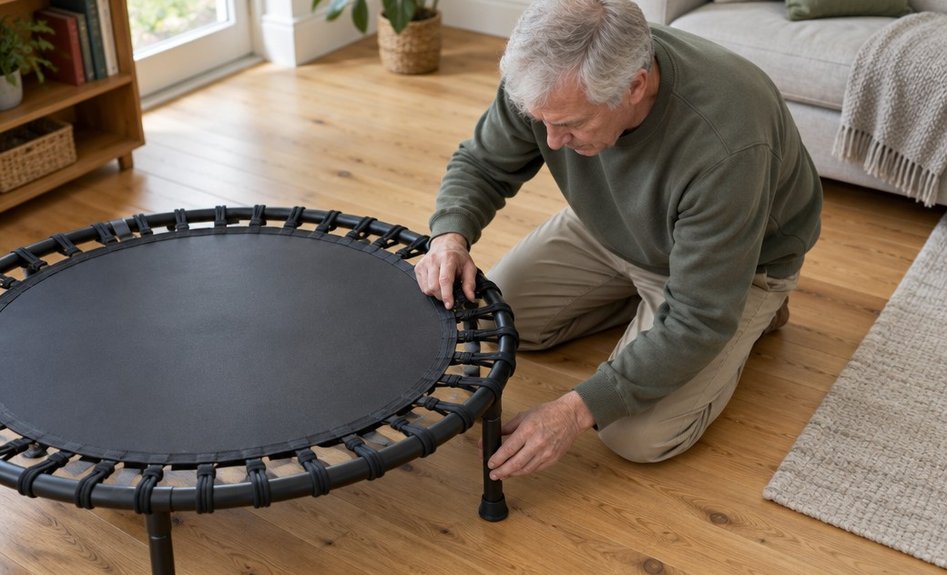
Check four things before you buy.
- The handle range and where it is measured. Compare the lowest and highest settings with where you want your hands to rest. A range measured from the mat is easier to picture than one with no starting point.
- The weight limit. Choose a rebounder rated above your weight. The JUMPZYLLA and ANCHEER listings each give two different figures, so ask the seller which one applies before you buy.
- Springs or bungee cords. Springs are metal coils; bungee cords are elastic. Both types appear above.
- The legs. The ZENOVA stands on six legs with anti-slip rubber, and the ANCHEER on six suction-cup legs. Check what the rebounder you choose stands on.
What three trials found
Balance scores improved after mini-trampoline training in all three trials below. They measured test scores and questionnaires, not falls.
- Posch and colleagues, 2019: a randomized trial of women aged 56 to 83 with osteopenia (lower than normal bone density). Twenty trained on the trampoline and 20 were controls. Sessions ran twice a week for 12 weeks, supervised, with supporting bars on the trampoline.
- What Posch reported: better balance, functional mobility, strength, gait performance and fear of falling. The program mixed balance, strength and jumping exercises, and the bone density difference between groups did not reach statistical significance.
- de Oliveira and colleagues, 2014: a randomized trial of 74 physically independent women, average age 69. They trained on a mini-trampoline, in water or on the floor for 12 weeks. All three groups improved postural balance; the trampoline was not reported as better than the others.
- Kendall and colleagues, 2026: 47 adults averaging 71, assigned (not randomized) to trampoline or walking. Sessions lasted 20 minutes, three times a week, for 6 weeks. Both groups improved balance and walking capacity, and only the trampoline group improved single-leg balance.
Your first sessions: hold on, bounce in place
- Hold the bar with both hands. The Posch trial mounted supporting bars on the trampoline to protect participants from falling.
- Bounce in place. It was one of the exercises in the Posch program.
- Have someone nearby. An instructor attended every Posch session. The National Institute on Aging (NIA) advises a sturdy chair, person or wall nearby to hold onto. The NIA is the part of the US National Institutes of Health that leads federal research on aging.
For length, the trials give a range: Kendall’s 20-minute sessions three times a week, and Posch’s 45-60-minute sessions twice a week. Those are what the researchers used. They are not a prescription, so ask your doctor what fits you.
When to ask your doctor before bouncing
If you have osteoporosis and have broken a bone, ask your doctor before you buy.
The Bone Health & Osteoporosis Foundation (BHOF) is a US health organization dedicated to preventing and treating osteoporosis and fractures.
It says people who have broken a bone due to osteoporosis, or are at risk of breaking one, may need to avoid high-impact exercises.
If unsure, it says to check with a healthcare provider.
For people with osteoporosis, the NIA says to talk with your health care provider about activity that is safe for you and good for your bone health.
The NIA also suggests seeking guidance from your doctor or physical therapist when you are unsure about a particular movement.
Cleveland Clinic, a non-profit academic medical center in Ohio, says the same of rebounders. Check with your doctor if you have concerns about your ability to use one.
Matching the bar to your height and weight
Shorter readers get the lowest listed bar on the KOKSRY. The ANCHEER has the lowest bottom setting measured from the mat.
For a taller reader, the ZENOVA is the first to look at. It has the highest top setting measured from the mat. The JUMPZYLLA gives a higher top figure, but with no stated starting point.
If bouncing sounds like more than you want, gentler, low-impact options include walking, swimming and cycling.
Anyone above 330 lb should go to the KOKSRY, the only one of the four with a single consistent limit above that, 450 lb. At or under 330 lb, the ZENOVA is the first rebounder to look at.